
Joint Parliamentary Committee Backs One Nation, One Election Framework | 12th July 2026 Complete Analysis
Breaking News: 12th July 2026
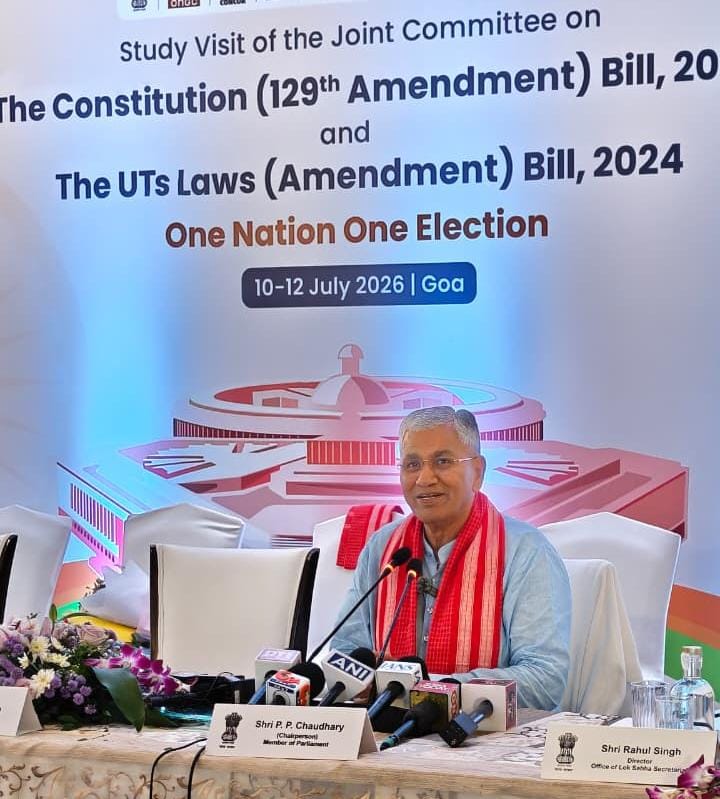
The Joint Parliamentary Committee concludes its two-day Goa consultations on One Nation, One Election, signaling strong backing for the simultaneous elections framework. The JPC has now visited 10 states and is building consensus for a historic constitutional reform.
On 12th July 2026, the Joint Parliamentary Committee (JPC) examining the Constitution (129th Amendment) Bill, 2024 and the Union Territories Laws (Amendment) Bill, 2024 wrapped up its crucial two-day consultations in Goa. This marks a significant milestone in India's journey toward implementing One Nation, One Election (ONOE) — one of the most debated and consequential electoral reforms in the country's democratic history.
Chaired by BJP MP P.P. Chaudhary, a former Union Minister of State for Law and Justice, the 39-member committee has been touring the nation to gather views from state governments, political parties, constitutional experts, civil society, and the media. The Goa visit, held on 10th and 11th July 2026, was the committee's ninth state consultation and has generated considerable buzz across political and legal circles.
In this comprehensive article, we break down everything you need to know about the JPC's Goa consultations, the One Nation One Election framework, its constitutional implications, the arguments for and against it, and what this means for the future of Indian democracy. Whether you are a law student, a civil services aspirant, or a concerned citizen, this guide will give you a clear, in-depth understanding of this landmark reform.
What Happened at the JPC Goa Consultations on 10-11 July 2026?
The Joint Parliamentary Committee's visit to Goa was not just another routine consultation. It was a carefully structured engagement designed to capture diverse perspectives on the proposed simultaneous elections framework. Over two days, the committee held multiple rounds of discussions with a wide cross-section of stakeholders.
Day 1: Meetings with the State Executive and Experts
On the first day, 10th July 2026, the JPC met with Goa Chief Minister Dr Pramod Sawant, representatives of recognized political parties, constitutional experts, the State Election Commission, and officials of Goa University. The discussions covered the practical challenges of implementing simultaneous elections in a small but politically vibrant state like Goa, where assembly elections have historically seen high voter turnout and intense multi-party competition.
Day 2: Interaction with Legislature and Opposition
On the concluding day, 11th July 2026, the committee interacted with Goa Legislative Assembly Speaker Dr Ganesh Gaunker, Leader of Opposition Yuri Alemao, and members of the Legislative Assembly from different political parties. This was particularly significant because it allowed the JPC to hear directly from elected representatives who would be directly affected by the proposed changes to election cycles.
JPC Chairman P.P. Chaudhary used the occasion to reiterate the committee's position. He stated that simultaneous elections would strengthen governance, reduce expenditure, and minimize disruptions caused by frequent polls. He also clarified a common misconception: One Nation One Election does not mean voting across the entire country on a single day. Instead, it means conducting Lok Sabha and Assembly elections together in phases, but only once every five years.
"One Nation One Election does not mean all voting will happen on a single day. Elections will be held together in phases, based on the Election Commission's convenience. This is a major election reform that future generations will remember." — P.P. Chaudhary, JPC Chairman
The committee also announced that its next stop would be Lucknow, continuing its nationwide outreach before finalizing recommendations.
Understanding One Nation, One Election: What Does It Really Mean?
Before diving deeper into the JPC's recommendations and the controversy surrounding them, let us first understand what One Nation, One Election actually proposes. In simple terms, ONOE seeks to synchronize the election cycles of the Lok Sabha (the lower house of Parliament) and all State Legislative Assemblies so that they are held together, either on a single day or within a specific time frame.
The Two Bills Under JPC Review
The JPC is specifically examining two critical pieces of legislation:
- Constitution (129th Amendment) Bill, 2024: This bill empowers the Election Commission of India to conduct elections for the Lok Sabha and all State Assemblies simultaneously. It proposes amendments to Articles 83 (duration of Parliament) and Article 172 (duration of State Legislatures) to align their terms.
- Union Territories Laws (Amendment) Bill, 2024: This bill extends the simultaneous election framework to Union Territory Assemblies, ensuring that Delhi, Puducherry, Jammu & Kashmir, and other UTs also follow the synchronized cycle.
How Will Synchronization Work?
The bills propose a phased approach to implementation:
- Phase 1: Synchronize Lok Sabha and State Legislative Assembly elections. The terms of all State Assemblies constituted after a notified date will expire with the expiry of the full term of the Lok Sabha.
- Phase 2: Hold elections for Panchayats and Municipalities within 100 days of the general elections.
- Appointed Date: The President will notify an "appointed date" after the upcoming general elections to mark the new electoral cycle, likely starting from 2029.
If a Lok Sabha or State Assembly is dissolved prematurely before completing its five-year term, a fresh election will be held only for the remainder of the term, not a full five-year term. This ensures that the synchronization is maintained.
Historical Background: India Has Done This Before
One of the most common misconceptions about One Nation One Election is that it is a completely new idea. The truth is, India held simultaneous elections for the first four general elections after independence. Here is a quick look at the history:
| Year | Event | Significance |
|---|---|---|
| 1951-52 | First General Elections | Lok Sabha and all State Assembly elections held together for the first time |
| 1957 | Second General Elections | Simultaneous elections continued successfully |
| 1962 | Third General Elections | Third consecutive simultaneous election cycle |
| 1967 | Fourth General Elections | Last time simultaneous elections were held before the cycle broke |
| 1968-69 | Premature Dissolutions | Several State Assemblies dissolved early, breaking the synchronized cycle |
| 1970 | Lok Sabha Dissolved | Fourth Lok Sabha dissolved early, completely desynchronizing elections |
| 1983 | Election Commission Recommendation | ECI first recommended returning to simultaneous elections |
| 1999 | Law Commission 170th Report | Recommended simultaneous elections as a reform measure |
| 2015 | Parliamentary Standing Committee | Recommended simultaneous elections to improve governance efficiency |
| 2017 | NITI Aayog Working Paper | Analyzed feasibility and economic benefits of ONOE |
| 2023-24 | Kovind Committee Report | High-level committee under former President Ram Nath Kovind submitted 18,000-page report |
| Dec 2024 | Bills Introduced in Lok Sabha | Constitution (129th Amendment) Bill and UT Laws Amendment Bill introduced |
| July 2026 | JPC Goa Consultations | JPC concludes 9th state visit, building consensus for ONOE framework |
As you can see, the idea of simultaneous elections is deeply rooted in India's post-independence democratic practice. The cycle was disrupted not by design, but by the political instability of the late 1960s and early 1970s, including premature dissolutions and the Emergency.
Expert Committees That Have Recommended Simultaneous Elections
The push for One Nation One Election is not a recent phenomenon. Over the past four decades, multiple expert bodies have examined the issue and recommended its implementation. Here is a comprehensive table:
| Committee/Body | Year | Key Recommendation |
|---|---|---|
| Election Commission of India | 1983 | First official recommendation to return to simultaneous elections |
| Law Commission of India | 1999 (170th Report) | Recommended simultaneous elections to reduce costs and governance disruption |
| Law Commission of India | 2015 (255th Report) | Reiterated recommendation with detailed constitutional analysis |
| Parliamentary Standing Committee | 2015 | Recommended holding Lok Sabha and Assembly elections together |
| NITI Aayog | 2017 | Working paper highlighted economic benefits and logistical feasibility |
| High-Level Committee (Kovind Committee) | 2024 | Recommended phased implementation starting 2029; 18 constitutional amendments needed |
| Joint Parliamentary Committee | 2025-26 | Currently examining bills; nationwide consultations ongoing |
The fact that so many independent and bipartisan bodies have supported the concept lends significant credibility to the proposal. However, the devil is always in the details, and the JPC's current examination is precisely about getting those details right.
JPC Key Findings: The Numbers That Matter
During its nationwide consultations, the JPC has highlighted several compelling statistics that form the backbone of its argument for One Nation One Election. Here are the key figures:
| Parameter | Figure | Source/Context |
|---|---|---|
| Potential Savings | Rs 7 Lakh Crore | JPC estimate from reduced election expenditure and administrative costs |
| GDP Growth Boost | Up to 1.6% | JPC claim based on reduced governance disruption |
| Public Responses to Kovind Committee | 21,558 | 81% in favour of simultaneous elections |
| Political Party Responses | 47 parties | 32 supported, 15 opposed |
| JPC Members | 39 MPs | 27 from Lok Sabha, 12 from Rajya Sabha |
| States Visited by JPC (till July 2026) | 10 states | Mumbai, Dehradun, Chandigarh, Shimla, Bengaluru, Gandhinagar, Goa, and others |
| Additional EVMs Needed | Rs 9,300 Crore | NITI Aayog estimate for EVMs and VVPATs |
| Constitutional Amendments Required | 18 amendments | Kovind Committee recommendation |
| Target Year for Implementation | 2029 / 2034 | First synchronized cycle by 2029; full alignment by 2034 |
Key Insight: The JPC claims that simultaneous elections could add nearly Rs 7 lakh crore to the Indian economy by reducing repeated election-related expenditure and administrative disruptions. This figure has been a central talking point in the committee's public outreach.
Arguments in Favour of One Nation One Election
The proponents of ONOE, including the JPC Chairman and several expert committees, have put forward a range of arguments supporting the reform. Here is a detailed breakdown:
1. Massive Financial Savings
Conducting elections in India is an enormously expensive affair. The 2019 Lok Sabha elections alone cost approximately Rs 60,000 crore when you factor in government expenditure, party spending, and candidate expenses. When you add the costs of multiple state elections held throughout the year, the total bill runs into lakhs of crores. Simultaneous elections would consolidate these costs, reducing the financial burden on the exchequer, political parties, and candidates.
2. Reduced Governance Disruption
One of the most significant but often overlooked costs of frequent elections is the disruption to governance. When the Election Commission announces elections, the Model Code of Conduct (MCC) comes into force, which restricts the government from announcing new policies, schemes, or projects. With elections happening in some state or the other almost every few months, the MCC is in force for a significant portion of the year. This creates what critics call "policy paralysis" and delays developmental work.
3. Efficient Use of Administrative Machinery
Frequent elections require the repeated deployment of government officials, teachers, and security personnel. For instance, the 2024 general elections required 82 days of phased deployment of security forces and polling staff. Teachers are regularly pulled away from classrooms for election duty. Simultaneous elections would reduce this burden, allowing administrative machinery to focus on its primary responsibilities.
4. Focus on Long-Term Governance
When elections are held every few months, political parties remain in perpetual campaign mode. This encourages short-term populist policies aimed at immediate electoral gains rather than long-term national development. ONOE would allow governments to focus on governance for five full years without the distraction of constant campaigning.
5. Higher Voter Turnout
When voters can cast their ballots for both central and state governments on the same day, participation becomes more convenient. This could potentially lead to higher voter turnout, especially in large states where traveling to polling stations multiple times a year can be burdensome for rural voters.
6. Reduced Political Polarization
Continuous election cycles often keep political rhetoric heated and divisive. By reducing the frequency of elections, ONOE could help lower the temperature of political discourse and reduce the constant polarization that affects social harmony.
7. Strengthened Cooperative Federalism
A harmonized electoral calendar encourages coordination between the Union and States, ensuring policy stability and reducing political friction from perpetual campaign cycles. It aligns the democratic mandate of both levels of government, creating a more cohesive governance framework.
Arguments Against One Nation One Election
Despite the compelling arguments in favour, the opposition to ONOE is equally strong and rooted in serious constitutional and democratic concerns. Here are the main counter-arguments:
1. Threat to Federalism
This is perhaps the most significant criticism. Critics argue that national and state issues are fundamentally different. Holding elections together may lead voters to prioritize national agendas over regional concerns, effectively "nationalizing" state elections. This could weaken regional parties and reduce the diversity of political representation that is essential to India's federal structure. The Supreme Court's landmark judgment in S.R. Bommai vs Union of India (1994) emphasized the importance of federalism as part of the Constitution's basic structure.
2. Marginalization of Regional Parties
Regional parties, which play a crucial role in representing local interests, fear that simultaneous elections would put them at a disadvantage. National parties with greater resources and media presence could dominate the narrative, making it harder for regional parties to compete on equal terms. As one academic study noted, "National mania dominates local issues in ONOE" — the national agenda tends to overshadow state-specific concerns.
3. Constitutional and Legal Hurdles
Implementing ONOE requires extensive amendments to the Constitution. The Kovind Committee identified 18 constitutional amendments needed, most importantly to Articles 83 and 172. Additionally, changes to the Representation of the People Act, 1951 would be necessary. Some of these amendments, particularly those affecting federal provisions, would require ratification by at least half of the state legislatures — a politically challenging task.
4. The "Remainder of Term" Problem
What happens if a government falls before completing its five-year term? The bills propose that a fresh election be held only for the remainder of the term. But this creates its own problems. A government elected for just one or two years would have limited time to implement policies, creating instability. JPC Chairman P.P. Chaudhary himself acknowledged that "the decision to have a cut-off time to determine the remainder of the term will have to be a political decision in consultation with parties."
5. Risk of Increased President's Rule
Critics fear that synchronizing elections could lead to more frequent use of Article 356 (President's Rule) to manage situations where a government falls mid-term. This would centralize power and undermine state autonomy — a concern that has been raised by constitutional experts and opposition parties alike.
6. Logistical Challenges
Conducting simultaneous elections across India's 28 states and 8 Union Territories is a logistical mammoth task. The NITI Aayog estimated that an additional Rs 9,300 crore would be needed for EVMs and VVPATs alone. Managing security, polling staff, and monitoring across the entire country simultaneously would strain the Election Commission's capacity.
7. Reduced Accountability
Some critics argue that frequent elections, while disruptive, serve an important democratic function: they keep governments accountable. If voters are unhappy with a state government's performance, they can express their displeasure in the next state election, which might be just a year or two away. With ONOE, this mid-term accountability mechanism would be weakened.
8. The "One Nation, No Election" Fear
The Indian National Congress has quipped that the Modi government is preparing for a "One Nation, No Election" scenario. While this is political rhetoric, it reflects a genuine fear among opposition parties that ONOE could be a step toward concentrating power and eroding democratic checks and balances.
Constitutional Amendments Required for One Nation One Election
The implementation of ONOE is not a simple legislative change. It requires fundamental alterations to the Constitution of India. Here is a detailed table of the key amendments needed:
| Article | Current Provision | Proposed Change |
|---|---|---|
| Article 83 | Duration of Houses of Parliament (5 years for Lok Sabha) | Alignment provisions to synchronize Lok Sabha term with state cycles |
| Article 85 | President's power to summon, prorogue, and dissolve Parliament | May need changes to handle premature dissolution scenarios |
| Article 172 | Duration of State Legislatures (5 years for Assemblies) | Curtailing or extending terms to align with Lok Sabha cycle |
| Article 174 | Governor's power to summon, prorogue, and dissolve Assembly | Similar changes as Article 85 for state level |
| Article 327 | Parliament's power to make laws regarding elections | Empowering Parliament to legislate for simultaneous elections |
| New Article 82A | Does not exist | Empowers President to notify an "appointed date" for synchronization |
| New Article 324A | Does not exist | Allows simultaneous elections for Panchayats and Municipalities |
| Article 325 | No person to be ineligible for inclusion in electoral roll | Empowers ECI to create common electoral roll and EPIC with state ECs |
In addition to these, the Representation of the People Act, 1951 would need amendments to accommodate the new election cycle. The Anti-Defection Law might also require updates to handle scenarios of premature dissolution more effectively.
Important: The Kovind Committee recommended that states must ratify amendments to Articles 324A and 325 since they affect the federal structure. This means at least 15 out of 28 state legislatures must approve these changes.
Comparative Analysis: ONOE Pros and Cons at a Glance
To help you quickly grasp the debate, here is a side-by-side comparison of the major arguments:
| Aspect | Arguments IN FAVOUR | Arguments AGAINST |
|---|---|---|
| Cost | Saves Rs 7 lakh crore; reduces party and candidate spending | Initial investment of Rs 9,300 crore for EVMs/VVPATs needed |
| Governance | Reduces MCC disruption; allows 5 years of focused governance | May reduce mid-term accountability of governments |
| Federalism | Strengthens cooperative federalism through aligned mandates | Threatens state autonomy; nationalizes local issues |
| Regional Parties | Voters are mature enough to choose differently at different levels | National parties with more resources will dominate |
| Administration | Reduces burden on officials, teachers, and security forces | Logistically challenging to manage nationwide simultaneously |
| Democracy | Higher voter turnout; more convenient for citizens | May weaken democratic checks and local representation |
| Economy | Boosts GDP by 1.6%; attracts foreign investment through stability | Savings are only 0.03% of GDP; marginal economic impact |
| Constitution | Restores original practice of 1952-1967 | Requires 18 amendments; may affect basic structure |
What Happens Next? The Road Ahead for ONOE
With the JPC concluding its Goa consultations on 12th July 2026, what lies ahead for the One Nation One Election proposal? Here is the likely roadmap:
1. Remaining JPC Consultations
The committee has announced that its next visit will be to Lucknow. It is expected to continue visiting more states and Union Territories to gather additional stakeholder inputs. The JPC's tenure has been extended until the first day of the last week of the Monsoon Session 2026, but sources suggest it may seek further extension given the complexity of the issue.
2. Drafting the JPC Report
After completing consultations, the JPC will draft its comprehensive report. This report will include:
- A summary of stakeholder views from across the country
- Recommendations on constitutional amendments needed
- Suggestions for handling premature dissolutions
- Proposed timeline for implementation
- Dissent notes from opposition members (if any)
3. Parliamentary Debate and Voting
Once the JPC submits its report, the bills will be discussed in both Houses of Parliament. Since these are constitutional amendment bills, they require a special majority — at least two-thirds of members present and voting in each House. In the Lok Sabha, this means at least 362 votes out of 540 members. The government will need to build broad consensus to achieve this.
4. State Ratification
For amendments affecting federal provisions (like Articles 324A and 325), at least 15 state legislatures must ratify the changes. This is where the real political challenge lies, as several opposition-ruled states may resist the amendments.
5. Implementation Timeline
If all goes according to plan, the government aims to have the first synchronized election cycle in 2029, with full alignment achieved by 2034. This phased approach gives time for logistical preparation and political consensus-building.
Legal Perspective: Will ONOE Survive Judicial Scrutiny?
Any major constitutional amendment in India eventually faces the test of judicial review. The Supreme Court has the power to strike down amendments that violate the basic structure of the Constitution, as established in the landmark Kesavananda Bharati vs State of Kerala (1973) case.
The key legal questions that courts may examine include:
- Does ONOE violate federalism? Federalism is considered part of the basic structure. If the Supreme Court finds that simultaneous elections fundamentally alter the federal character of the Constitution, it could strike down relevant amendments.
- Does it undermine democratic representation? Democracy and free & fair elections are also part of the basic structure. If the court finds that ONOE reduces the quality of representation or voter choice, it may intervene.
- Is the "remainder of term" provision constitutional? The idea that a newly elected government serves only the remainder of the previous government's term raises questions about the legitimacy of the electoral mandate.
- Does it affect the separation of powers? Giving the Election Commission power to defer state elections could raise concerns about judicial and legislative oversight.
However, JPC Chairman P.P. Chaudhary has stated that former Chief Justices of India, constitutional experts, and economists who appeared before the committee have broadly stated that the proposed legislation is consistent with the Constitution and is not against the federal structure or democratic principles.
Legal Precedent: The Supreme Court has previously upheld amendments that give priority to Directive Principles over certain Fundamental Rights (as in the 25th Amendment), but it has consistently protected the basic structure of the Constitution. Any ONOE amendment would need to pass this rigorous test.
Related Constitutional Resources on Barristery.in
At Barristery.in, we have covered several constitutional topics that are directly relevant to understanding the One Nation One Election debate. Here are some must-read articles from our website:
- The Constitution of India — Complete Guide with All Parts and Articles — A comprehensive breakdown of every Part of the Indian Constitution, including Part XV (Elections) which covers Articles 324-329A dealing with the Election Commission and electoral laws. Essential reading to understand the constitutional framework ONOE seeks to amend.
- One Nation One Election: Essay, Challenges, Advantages and Disadvantages — Our detailed essay on ONOE covering its historical background, advantages like cost reduction and governance continuity, and challenges including threats to federalism and regional parties. A perfect companion piece to this JPC analysis.
- Kesavananda Bharati vs State of Kerala, 1973 — The Basic Structure Doctrine — Understand the landmark case that established the "basic structure" doctrine. This is crucial because any ONOE constitutional amendment must not violate the basic structure, including federalism and democratic representation.
- Minerva Mills vs Union of India, 1980 — Judicial Review and Constitutional Balance — This case reinforced that Fundamental Rights and Directive Principles must coexist in harmony. It is relevant to the ONOE debate because the proposal seeks to balance governance efficiency (a Directive Principle goal) with democratic rights.
- 19th Amendment of the Indian Constitution — Election Tribunals and Judicial Clarity — Learn about the amendment that removed the Election Commission's power to appoint election tribunals, strengthening judicial oversight in election matters. Relevant to understanding how election-related constitutional amendments have evolved.
- Article 81 of the Indian Constitution — Composition of the Lok Sabha — Understand how Lok Sabha representation works, including the freeze on delimitation based on the 1971 census. This is relevant because ONOE will affect how and when Lok Sabha elections are held.
- Indira Gandhi vs Raj Narain (1975) — Election Law and Judicial Power — The historic case that unseated a sitting Prime Minister for corrupt electoral practices under the Representation of the People Act, 1951. A landmark in Indian election law that shows the judiciary's role in safeguarding electoral integrity.
- Bare Acts of Indian Laws — Download PDF — Access the full text of the Representation of the People Act, 1951 and other election-related laws that ONOE seeks to amend. Essential for legal research and exam preparation.
Conclusion: A Defining Moment for Indian Democracy
The Joint Parliamentary Committee's Goa consultations on 10-12 July 2026 represent a critical waypoint in India's most significant electoral reform since independence. The committee's apparent backing of the One Nation One Election framework signals that the government is serious about pushing this proposal through, despite the formidable constitutional and political challenges ahead.
Whether One Nation One Election proves to be a game-changing reform that streamlines governance and saves public money, or a threat to federalism and democratic representation, depends largely on how the final legislation is crafted. The JPC's recommendations will be crucial in determining whether the proposal strikes the right balance between efficiency and democratic values.
What is clear is that this debate touches the very core of how India practices democracy. It raises fundamental questions about federalism, representation, accountability, and the relationship between the Centre and the States. As citizens, it is our responsibility to engage with these questions thoughtfully and demand that our elected representatives get the details right.
The JPC has promised to consider all suggestions received from stakeholders across the country before submitting its report. The committee's next stop is Lucknow, and the nation will be watching closely. One thing is certain: the outcome of this process will shape Indian democracy for decades to come.
Stay Informed: Bookmark this page and visit Barristery.in regularly for the latest updates on One Nation One Election, constitutional law, and Indian polity. We simplify complex legal topics so every citizen can understand their rights and the laws that govern them.
Last Updated: 12th July 2026 | Article Published on Barristery.in


COMMENTS