
PCMA and POCSO Act Override Personal Law on Child Marriage 2026 — Complete Legal Analysis with Supreme Court & High Court Judgments
Child marriage has been one of the most deeply rooted social evils in India for centuries. Despite numerous laws, constitutional mandates, and international commitments, millions of children — especially girls — continue to be pushed into matrimony before they reach adulthood. The legal landscape surrounding child marriage in India has always been complicated, primarily because of the conflict between statutory child protection laws and personal laws that govern marriage within different religious communities.
However, 2024 and 2025 have brought a seismic shift in this legal battleground. Courts across India — from the Supreme Court to various High Courts — have delivered landmark judgments affirming that the Prohibition of Child Marriage Act, 2006 (PCMA) and the Protection of Children from Sexual Offences Act, 2012 (POCSO Act) universally override personal laws, irrespective of religion. This article provides a comprehensive, detailed analysis of these developments, the legal reasoning behind them, and what they mean for every citizen of India.
Understanding the Legal Framework: PCMA, POCSO, and Personal Laws
Before diving into the recent judgments, it is essential to understand the three pillars of law that are at the center of this debate. Each of these laws serves a distinct purpose, but their intersection creates the legal tension that courts have been resolving.
What is the Prohibition of Child Marriage Act, 2006 (PCMA)?
The Prohibition of Child Marriage Act, 2006 was enacted by the Parliament of India to replace the outdated Child Marriage Restraint Act, 1929. The primary objective of the PCMA is to prohibit the solemnization of child marriages and to provide for matters connected therewith or incidental thereto. The Act defines a "child" as a male who has not completed 21 years of age and a female who has not completed 18 years of age.
Key provisions of the PCMA include:
- Section 3: Every child marriage, whether solemnized before or after the commencement of this Act, shall be voidable at the option of the contracting party who was a child at the time of the marriage.
- Section 9: A male adult above 18 years who contracts a child marriage shall be punishable with rigorous imprisonment up to 2 years or with fine up to Rs 1 lakh or both.
- Section 10: Whoever performs, conducts, or directs any child marriage shall be punishable with rigorous imprisonment up to 2 years and fine up to Rs 1 lakh.
- Section 11: Parents or guardians who permit or promote child marriage shall also face similar punishment (women are exempt from imprisonment).
- Section 12: Child marriages involving kidnapping, abduction, or trafficking of a minor are declared null and void.
- Section 13: Courts can issue injunctions to prohibit child marriages.
The PCMA applies to the whole of India and also to all citizens of India beyond India. This universal applicability is a crucial factor in the debate over whether personal laws can override it.
What is the Protection of Children from Sexual Offences Act, 2012 (POCSO Act)?
The POCSO Act, 2012 is a comprehensive law enacted to protect children from offences of sexual assault, sexual harassment, and pornography. The Act defines a "child" as any person below the age of 18 years. It is gender-neutral and covers all children, regardless of their religion, caste, or community.
Key provisions relevant to child marriage include:
- Section 3: Defines Penetrative Sexual Assault and makes it punishable with imprisonment of 7 years to life.
- Section 5: Defines Aggravated Penetrative Sexual Assault, which includes sexual assault by a person in a position of trust or authority, including a family member. This is punishable with rigorous imprisonment of not less than 10 years, extending to life imprisonment.
- Section 42A: This is the most critical provision. It states that "the provisions of this Act shall be in addition to and not in derogation of the provisions of any other law for the time being in force and, in case of any inconsistency, the provisions of this Act shall have overriding effect on the provisions of any such law to the extent of the inconsistency."
Section 42A of the POCSO Act is the legal weapon that ensures the Act overrides any other law — including personal laws — when there is a conflict. This provision has been repeatedly cited by courts in their judgments against child marriage.
What are Personal Laws in India?
Personal laws in India are religious laws that govern marriage, divorce, inheritance, and adoption for different communities. The most prominent personal laws include:
- Hindu Marriage Act, 1955 — Governs Hindus, Buddhists, Jains, and Sikhs.
- Muslim Personal Law (Shariat) Application Act, 1937 — Governs Muslims.
- Indian Christian Marriage Act, 1872 — Governs Christians.
- Parsi Marriage and Divorce Act, 1936 — Governs Parsis.
- Special Marriage Act, 1954 — Governs inter-religious and civil marriages.
The conflict arises primarily with Muslim Personal Law, which traditionally permits marriage upon attainment of puberty (presumed at 15 years for girls). This has been the central point of legal debate, as it directly contradicts the PCMA's minimum age of 18 for girls and 21 for boys.
The Core Conflict: Personal Law vs. Statutory Child Protection Laws
The legal tension between personal laws and child protection statutes is not new. It has been brewing in Indian courts for decades. The fundamental question is simple but profound: When personal law permits something that statutory law prohibits, which one prevails?
Under Muslim Personal Law, a girl who has attained puberty (presumed at 15 years) is considered competent to marry. This is known as the "Option of Puberty" or "Khyar-ul-Bulugh." Several historical judgments, including those by the Privy Council and various High Courts, have recognized this principle. For instance, in Nawab Sadiq Ali Khan v. Jaya Kishori, the Privy Council held that majority for a girl child is attained at the age of 9 under Muslim law.
However, the PCMA and POCSO Act set the minimum age of marriage at 18 years for girls and 21 years for boys, and criminalize any sexual activity with a person below 18 years. This creates a direct conflict:
| Aspect | Muslim Personal Law | PCMA / POCSO Act |
|---|---|---|
| Minimum Age for Girls | Puberty (presumed at 15 years) | 18 years |
| Minimum Age for Boys | Puberty (presumed at 15 years) | 21 years |
| Validity of Marriage Below Age | Valid if with guardian's consent | Voidable at option of child; null if trafficking involved |
| Sexual Relations with Minor Spouse | Permitted within marriage | Criminalized as aggravated penetrative sexual assault |
| Punishment for Offenders | No specific punishment | Up to 2 years imprisonment + Rs 1 lakh fine (PCMA); 10 years to life (POCSO) |
This table clearly illustrates the stark differences between personal law and statutory child protection laws. The question for the courts has been: Which framework should take precedence?
Supreme Court Judgment October 2024: PCMA Cannot Be Stunted by Personal Laws
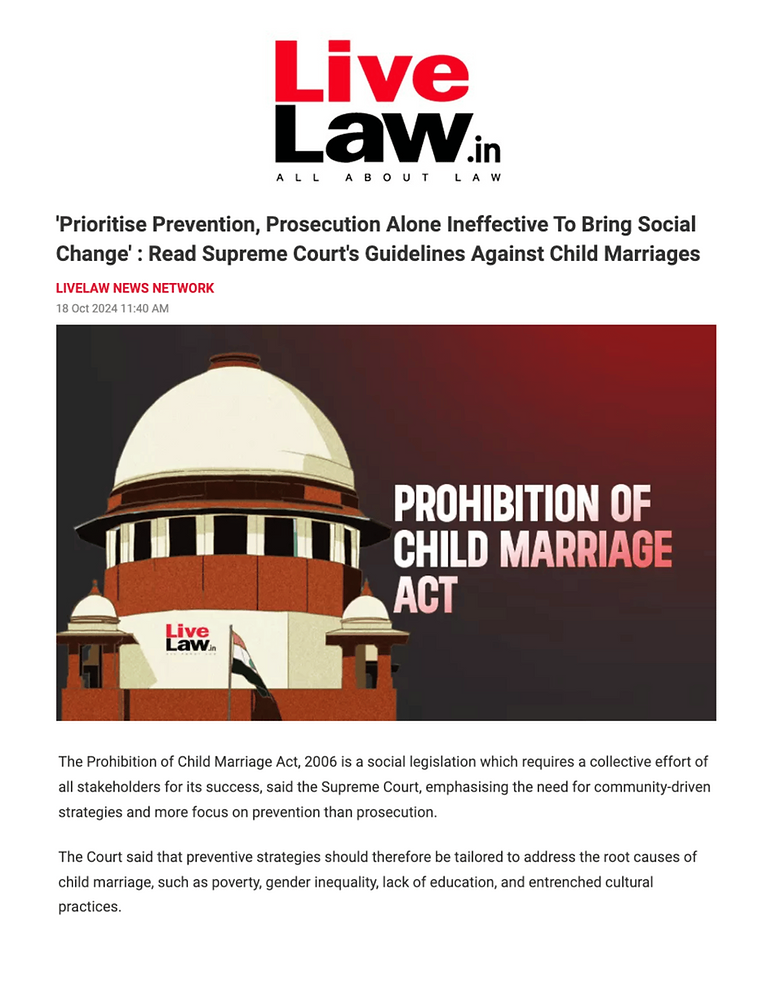
On October 18, 2024, the Supreme Court of India delivered a landmark judgment that has fundamentally reshaped the legal landscape around child marriage in India. A Bench comprising Chief Justice D.Y. Chandrachud and Justices J.B. Pardiwala and Manoj Misra held that "the law on the prevention of child marriages cannot be stunted by personal law."
Key Holdings of the Supreme Court
- Personal laws cannot override the PCMA: The Court categorically stated that the Prohibition of Child Marriage Act, 2006, is a social legislation that applies uniformly to all citizens, and no personal law can restrict its application.
- Child marriages violate free will: The Court held that marriages involving minors are violative of the minor's free will to choose a life partner. Children below the age of consent cannot exercise informed choice about marriage.
- Focus on prevention, not just prosecution: The Court emphasized that authorities must focus on prevention and protection of minors, with penalizing offenders being a last resort. A purely punitive approach is insufficient.
- Community-driven approach needed: The Court recommended "preventive strategies tailored to different communities" and stressed the need for multi-sectoral coordination between government agencies, law enforcement, and local communities.
- Training and capacity building: The Court directed that law enforcement officers must receive proper training to implement the PCMA effectively.
"Preventive strategy should be tailored to different communities, the law will only succeed when there is a multi-sectoral coordination. Training and capacity building of the law enforcement officers needs to be there. We emphasise that there needs to be community driven approaches." — Supreme Court of India, October 18, 2024
What the Supreme Court Did NOT Decide
It is important to note what the Supreme Court deliberately left open in its judgment. The Court refrained from deciding whether the PCMA explicitly overrides personal laws in all circumstances. This was because the Prohibition of Child Marriage (Amendment) Bill, 2021 was already pending before Parliament, which sought to explicitly state that the PCMA overrides personal laws. The Court noted that since Parliament is already addressing this issue, it would be inappropriate for the judiciary to pre-empt the legislative process.
However, the Court's strong language — stating that the PCMA "cannot be stunted by personal laws" — sent a clear signal to lower courts about the direction of constitutional interpretation.
Allahabad High Court July 2026: Shariat Law Runs in the Teeth of PCMA and POCSO
While the Supreme Court laid down broad principles, it was the Allahabad High Court that delivered the most direct and forceful judgment on the conflict between personal law and child protection statutes. In R and others v. State of U.P. (Neutral Citation: 2026:AHC:130283-DB), decided on July 8, 2026, a Division Bench of Justice J.J. Munir and Justice Achal Sachdev held that "no personal law can wipe out the prohibition of child marriage brought about by the PCMA, and the effect of the POCSO Act."
Background of the Case
The case arose from an incident in Village Sunpeda Baksuwa, Bulandshahr, Uttar Pradesh. On February 15, 2026, police and the Child Line Team intervened to prevent the child marriage of a 16-year-old girl. When officials attempted to rescue the minor for production before the Child Welfare Committee, they were allegedly assaulted and obstructed by 19 named persons and around 50 others, who briefly snatched the girl from official custody.
An FIR was registered at Police Station Kakor under various provisions of the Bharatiya Nyaya Sanhita, 2023, including offences relating to obstruction of public servants. The 19 accused approached the High Court seeking to quash the criminal proceedings.
Arguments of the Petitioners
The petitioners' counsel, Advocate Pooja, argued that:
- Under Muslim Personal Law, a girl who has attained the age of 15 is legally competent to marry.
- Such personal laws are protected by non-obstante clauses in the Majority Act, 1875, and the Muslim Personal Law (Shariat) Application Act, 1937.
- The Shariat Act is a special enactment that should prevail over the general enactment (PCMA).
- The marriage was valid under personal law, and therefore no offence was committed.
Arguments of the State
The state's law officers — Ghanshyam Kumar, Additional Government Advocate-I, and Shashi Shekhar Tiwari, Additional Government Advocate — strongly opposed the petition, defending the statutory duty exercised by the rescue teams. They argued that the PCMA and POCSO Act are modern, all-encompassing social safety statutes that override any contrary personal law provisions.
The Court's Landmark Ruling
The Allahabad High Court dismissed the petition and delivered a judgment that will be cited for decades to come. The Court held:
"The age of marriage, in our considered opinion, for every citizen of the country, irrespective of religion, is that, that is spelt out by the PCMA. Also, it is equally true that if the marriage of a person below 18 years were permitted, carnal relations being inseparable almost from the institution of marriage, it would be an acknowledged violation of the POCSO Act. The PCMA and the POCSO Act are statutes that are based on public health and national policy in this regard. They have a scientific understanding to them, legislatively translated into prohibitory statutes and there can be no escape from it for anyone."
"We have already expressed it and we say it again in tune with the line of authority that has held likewise, and that is that the Shariat Law providing for puberty as the competent age under the law permissible for a girl to marry or be married, runs clearly in the teeth of the PCMA as well as the POCSO Act."
The Court further observed that:
- The statutory age of marriage applies uniformly across communities.
- The PCMA and POCSO Act are based on public health and national policy, with a scientific understanding that has been legislatively translated into prohibitory statutes.
- No one can escape from the application of these laws, regardless of their religious beliefs.
- The allegations prima facie established a case of criminal obstruction and assault on public servants acting bona fide in their legal duties.
- Interdicting a thorough investigation at an incipient stage would be improper.
The Court dismissed the writ petition and vacated the interim stay order dated April 6, 2026.
Kerala High Court August 2024: Every Indian is a Citizen First, Religion Comes Later
Even before the Allahabad High Court's ruling, the Kerala High Court had set the stage with its own landmark judgment in Moidutty Musliyar v. State of Kerala (2024 SCC OnLine Ker 4188), decided on July 15, 2024. Justice P.V. Kunhikrishnan delivered a powerful message: "Every Indian is a citizen first, religion comes later."
Background of the Case
The case involved a child marriage that took place on December 30, 2012. The Integrated Child Development Scheme (ICDS) Officer submitted a complaint to the Circle Inspector of Police, leading to the registration of a case under Sections 10 and 11 of the PCMA. The accused included the father of the minor girl, the groom, and office-bearers of the mosque where the marriage was solemnized.
The accused argued that since the parties were Muslims, the marriage below 18 years was not void. They relied on the concept of "Khyar-ul-Bulugh" (Option of Puberty) under Mohammedan Law, which renders the marriage voidable at the instance of the girl upon attaining puberty.
The Court's Reasoning
The Kerala High Court rejected these arguments and held that:
- Section 1(2) of the PCMA states that the Act extends to the whole of India and applies to all citizens of India, irrespective of religion — whether Hindu, Muslim, Christian, Parsi, etc.
- Since the PCMA is applicable to all citizens, religion is secondary, and citizenship comes first.
- The Majority Act, 1875 was enacted in 1875, while the PCMA came into force on November 1, 2007. The later, more specific enactment (PCMA) overrides the earlier general law (Majority Act) as far as child marriage is concerned.
- The PCMA was enacted to eradicate the evil practice of child marriage and carries a more stringent punishment than the 1929 Act.
"The Prohibition of Child Marriage Act, 2006 prohibits child marriage, it supersedes the Muslim personal law, and every citizen of this country is subject to the law of the land, which is Act 2006, irrespective of his or her religion." — Kerala High Court, July 15, 2024
The Court also emphasized the human rights dimension of child marriage prohibition:
"The prohibition of child marriage is important in the modern society. Child marriage denies children their basic human rights, including the right to education, health, and protection from exploitation. Early marriage and pregnancy can lead to health problems such as infant mortality, maternal mortality, and sexually transmitted infections. Child marriage often forces girls to drop out of school, limiting their education and future opportunities."
The Court refused to quash proceedings against the accused persons and dismissed the petition.
Other Significant Judgments on PCMA, POCSO, and Personal Law Conflict
Beyond the Supreme Court, Allahabad High Court, and Kerala High Court, several other courts have contributed to this evolving jurisprudence. Here is a summary of the most important ones:
| Court & Year | Case Name | Key Holding |
|---|---|---|
| Karnataka High Court, 2024 | Seema Begum v. State of Karnataka | Rejected a Muslim girl's plea that she was not governed by PCMA. Held that PCMA applies uniformly to all citizens irrespective of religion. |
| Madras High Court, 2015 | Abdul Khader v. K. Pechiammal | Held that when statutory law governs a particular field, personal law becomes inapplicable. Cited Supreme Court precedents in Shabana Bano and Parayankandiyal cases. |
| Delhi High Court | Mrs. Tahra Begum v. State of Delhi | Held that a Muslim girl who attained puberty (15 years) can marry without guardian's consent. However, this was before the PCMA's full impact was realized. |
| Bombay High Court, 2025 | Mirza Aslam Beigh v. State of Maharashtra | Held that subsequent marriage or childbirth cannot erase POCSO criminal liability. Marriage is not a defence to child sexual abuse charges. |
| Madhya Pradesh High Court, 2025 | POCSO Conviction Appeal | Upheld POCSO conviction despite subsequent marriage and birth of child. Held that once the offence is complete, subsequent events are immaterial. |
| Punjab & Haryana High Court | Various POCSO Cases | Held that FIR for POCSO offence cannot be quashed on basis of compromise or marriage between accused and victim. |
These judgments collectively establish a consistent judicial trend: personal laws cannot be used as a shield against child protection statutes. The PCMA and POCSO Act are special, protective legislations that take precedence over general personal law provisions.
Legal Reasoning: Why PCMA and POCSO Override Personal Laws
The judgments discussed above are not arbitrary. They are grounded in well-established principles of statutory interpretation and constitutional law. Here is the detailed legal reasoning that courts have employed:
1. Doctrine of Harmonious Construction
When two laws appear to conflict, courts attempt to harmoniously construct them so that both can operate without contradiction. However, when harmonious construction is impossible — as in the case of child marriage, where one law permits and the other prohibits — courts must determine which law prevails.
2. Later Law Overrides Earlier Law (Lex Posterior Derogat Legi Priori)
The PCMA was enacted in 2006 and the POCSO Act in 2012. Both are significantly later than the Muslim Personal Law (Shariat) Application Act, 1937 and the Majority Act, 1875. Under the principle that a later law overrides an earlier one on the same subject, the PCMA and POCSO Act must prevail.
3. Special Law Overrides General Law (Generalia Specialibus Non Derogant)
While the Shariat Act is a special law for Muslims, the PCMA and POCSO Act are even more special — they are protective legislations specifically designed to protect children from a particular evil (child marriage and sexual abuse). Courts have held that protective special laws override general personal laws.
4. Public Policy and Public Health
The PCMA and POCSO Act are based on public health considerations and national policy regarding child welfare. They reflect a scientific understanding of child development, the physical and psychological harm caused by child marriage, and the need to protect children from sexual exploitation. Public policy considerations strongly favor the enforcement of these laws.
5. Constitutional Values: Articles 14, 15, 21, and 51A
The Constitution of India provides strong support for child protection:
- Article 14 (Right to Equality): Child marriage laws must apply uniformly to all citizens. Allowing exceptions based on religion would violate the right to equal protection of laws.
- Article 15 (Prohibition of Discrimination): Discriminating against girl children by permitting their marriage at a younger age violates Article 15(3), which allows special provisions for women and children.
- Article 21 (Right to Life and Personal Liberty): The Supreme Court has held that the right to life includes the right to live with human dignity, which encompasses protection from child marriage and sexual abuse.
- Article 51A(k) (Fundamental Duties): It is the duty of every citizen to renounce practices derogatory to the dignity of women, which includes child marriage.
6. International Obligations: UN Convention on the Rights of the Child (UNCRC)
India is a signatory to the UNCRC, which defines a child as any person below 18 years and obligates states to protect children from all forms of exploitation. The PCMA and POCSO Act are legislative measures to fulfill India's international obligations under the UNCRC.
7. Section 42A of the POCSO Act: The Overriding Clause
As discussed earlier, Section 42A explicitly states that the POCSO Act has an overriding effect over any other law in case of inconsistency. This is a clear legislative intent that courts have consistently enforced.
Practical Implications: What This Means for You
The judgments discussed above have far-reaching practical implications for every citizen of India. Whether you are a parent, a religious leader, a law enforcement officer, or a legal professional, here is what you need to know:
For Parents and Guardians
- No religious exemption: You cannot claim that your personal law permits child marriage. The PCMA applies to all citizens, regardless of religion.
- Criminal liability: Parents or guardians who permit, promote, or attend a child marriage can face rigorous imprisonment up to 2 years and a fine up to Rs 1 lakh.
- Women exempt from imprisonment: While women can be fined, they cannot be imprisoned under the PCMA.
- Rescue and rehabilitation: Children rescued from child marriages must be produced before the Child Welfare Committee (CWC) for rehabilitation.
For Religious Leaders and Marriage Officiants
- Solemnizing child marriage is a crime: Any person who performs, conducts, or directs a child marriage is punishable under Section 10 of the PCMA.
- POCSO liability: If the marriage involves a child below 18 years, and sexual relations occur, the officiant may also face charges under the POCSO Act for abetment.
- No defence of religious freedom: Religious freedom under Article 25 of the Constitution is subject to public order, morality, and health. Child marriage violates all three.
For Law Enforcement Officers
- Mandatory action: Police officers and Child Marriage Prohibition Officers (CMPOs) are duty-bound to prevent child marriages and rescue children.
- Injunction powers: Courts can issue injunctions prohibiting child marriages, and disobedience is punishable with imprisonment.
- Protection from obstruction: Anyone who obstructs officers from performing their duties under the PCMA commits a separate offence under the Bharatiya Nyaya Sanhita, 2023.
For Victims of Child Marriage
- Right to annulment: Any child who was married before reaching the age of majority can file a petition to annul the marriage within 2 years of attaining majority (i.e., before 20 years for girls and 23 years for boys).
- Maintenance and residence: The female contracting party is entitled to maintenance and residence until remarriage.
- Custody of children: Children born of child marriage are deemed legitimate, and custody is decided based on the child's welfare.
- Compensation: Victims can seek compensation under the POCSO Rules and state victim compensation schemes.
The Ground Reality: Child Marriage Statistics in India
Despite strong laws and judicial pronouncements, child marriage remains a significant challenge in India. Understanding the scale of the problem is crucial for effective intervention.
| Indicator | Data | Source |
|---|---|---|
| Women married before 18 (National average) | ~23.3% | NFHS-5 (2019-21) |
| Women married before 18 (Rural areas) | ~27% | NFHS-5 |
| Women married before 18 (Urban areas) | ~14.7% | NFHS-5 |
| Highest prevalence states | West Bengal, Bihar, Jharkhand, Rajasthan | NFHS-5 |
| PCMA cases registered (2022) | 3,563 cases listed for trial | NCRB / Supreme Court observation |
| Cases concluded with trial (2022) | Only 181 cases | Supreme Court observation |
| Estimated time to clear backlog | 19 years at current rate | India Child Protection Study |
| Child Marriage Prohibition Officers (UP) | 1 per district | Supreme Court observation |
| Child Marriage Prohibition Officers (Karnataka) | 58,522 across 31 districts | Supreme Court observation |
These statistics reveal a troubling reality: while laws are strong on paper, implementation remains weak. The Supreme Court itself noted that at the current rate of trial completion, it would take 19 years just to clear the backlog of 2022 cases. This highlights the urgent need for systemic reforms, not just legal pronouncements.
Supreme Court Guidelines for Preventing Child Marriages
In its October 2024 judgment, the Supreme Court issued comprehensive guidelines for preventing child marriages. These guidelines are binding on all states and Union Territories:
- District and State Level Monitoring Units: Set up dedicated monitoring units to track child marriage cases and ensure coordination between different departments.
- Adequate Deployment of CMPOs: States must deploy sufficient Child Marriage Prohibition Officers, free from additional responsibilities, to focus solely on prevention duties.
- Age-Appropriate Sexuality Education: Introduce culturally sensitive sexuality education in schools to empower children with knowledge about their rights.
- Compensation Schemes: Establish compensation schemes for girls who opt out of child marriages, providing them with financial support for education and rehabilitation.
- Online Reporting Portal: Create a designated portal for online reporting of child marriages, making it easier for citizens to alert authorities.
- Earmarked Budget: Allocate specific budgets for child marriage prevention programs at the district level.
- Community Engagement: CMPOs must engage with communities, understand local factors driving child marriages, and work with NGOs and grassroots organizations.
- Training and Capacity Building: Regular training for law enforcement officers, judicial officers, and CMPOs on the PCMA, POCSO Act, and child rights.
- Convergent Action: Coordinate between departments of Women and Child Development, Education, Health, and Law Enforcement for a holistic approach.
- Treat Victims as Children in Need of Care and Protection: Under the Juvenile Justice Act, victims of child marriage must be provided with shelter, counseling, education, and rehabilitation.
Challenges and Gaps in the Current Legal Framework
Despite the strong legal framework and progressive judicial pronouncements, several challenges remain:
1. The Validity Question: Void or Voidable?
The PCMA declares child marriages as "voidable" (at the option of the child) rather than "void ab initio" (void from the beginning). This means a child marriage is technically valid until annulled by a court. The Supreme Court noted this gap but left it for Parliament to address through the pending Amendment Bill, 2021.
2. POCSO and Consensual Adolescent Relationships
The POCSO Act's blanket criminalization of all sexual activity with minors below 18 years has created challenges in cases of consensual adolescent relationships. Research by the Vidhi Centre for Legal Policy indicates that over 80% of "romantic" POCSO cases arise from parental objections rather than genuine exploitation. This has led to calls for "close-in-age" exceptions, though no legislative amendment has been made yet.
3. Implementation Gaps
- Inadequate CMPO deployment: Some states have only 1 CMPO per district, while others have thousands. This unevenness affects enforcement.
- Poor conviction rates: With only 181 trials concluded out of 3,563 cases in 2022, the deterrence value of the law is diminished.
- Lack of awareness: Many communities remain unaware of the PCMA and POCSO Act, leading to continued practice of child marriage.
- Economic factors: Poverty, dowry concerns, and safety perceptions continue to drive child marriage in many regions.
4. Conflict with RTE
The Right to Education (RTE) Act guarantees free and compulsory education only up to 14 years. Since most child marriages occur between 14 and 18 years, girls are deprived of education without any legal recourse. The Supreme Court did not address this gap in its October 2024 judgment.
Related Legal Resources on Barristery.in
At Barristery.in, we are committed to making Indian law accessible and understandable for every citizen. If you found this article helpful, explore these related resources from our website:
- Biswanath Singh Institute of Legal Studies, Munger — Complete Guide for Law Aspirants — Interested in pursuing law? This detailed guide covers admission process, fees, and career prospects at one of Bihar's emerging legal institutions. Understanding child protection laws begins with quality legal education.
- Legal Careers Portal — LL.B Jobs, Internships & Moot Court — Your one-stop destination for daily legal job alerts, internship opportunities, moot court competitions, and essay competitions. Aspiring lawyers can gain practical experience in child rights law through internships with NGOs and legal aid organizations.
- About Barristery.in — Your Legal Knowledge Partner — Learn more about our mission to make Indian law accessible, understandable, and actionable for every citizen, student, and legal professional. Our founder, Rabi Kumar Pandit, brings a unique multidisciplinary perspective to legal analysis.
Did You Know? Barristery.in is a focused, independent legal knowledge platform built by Rabi Kumar Pandit, a legal professional with a unique multidisciplinary background in History, Economics, and Law from the University of Calcutta. Every article is personally curated to ensure accuracy and usefulness for law students, legal professionals, and concerned citizens.
Conclusion: The Law is Clear — Child Protection Over Personal Law
The legal position in India is now unequivocally clear: the Prohibition of Child Marriage Act, 2006, and the Protection of Children from Sexual Offences Act, 2012, override all personal laws when it comes to the marriage and protection of children below 18 years of age. This position has been affirmed by the Supreme Court of India, the Allahabad High Court, the Kerala High Court, and numerous other courts across the country.
The reasoning is sound and rooted in constitutional values:
- Children are citizens first: Every child in India is entitled to the protection of the law, regardless of their parents' religion.
- Public health and national policy: Child marriage causes physical, psychological, and social harm that transcends religious boundaries.
- Scientific understanding: Modern medical and psychological science confirms that children below 18 are not capable of making informed decisions about marriage and sexual relationships.
- International obligations: India is bound by the UN Convention on the Rights of the Child to protect all children from exploitation.
- Constitutional mandate: Articles 14, 15, 21, and 51A of the Constitution demand equal protection, non-discrimination, and dignity for all children.
However, laws alone cannot end child marriage. As the Supreme Court wisely observed, "the law will only succeed when there is multi-sectoral coordination" and "community-driven approaches." We need:
- Better implementation: More CMPOs, faster trials, and higher conviction rates.
- Education and awareness: Age-appropriate sexuality education and community awareness programs.
- Economic empowerment: Addressing the root causes of poverty and gender inequality that drive child marriage.
- Rehabilitation support: Comprehensive care for victims, including education, counseling, and financial assistance.
- Religious leader engagement: Working with religious leaders to promote child marriage-free communities.
The judgments of 2024 and 2026 mark a turning point in India's fight against child marriage. They send a powerful message: no personal law, no religious custom, and no community tradition can override the fundamental right of a child to be protected from exploitation. As citizens, it is our collective responsibility to ensure these laws are not just words on paper but living protections for every child in India.
Stay Informed: Bookmark this page and visit Barristery.in regularly for the latest legal updates, Supreme Court judgments, High Court rulings, and comprehensive analysis of Indian law. We are committed to keeping you informed and empowered.
Last Updated: July 2026 | Article Published on Barristery.in | Legal Analysis for Educational Purposes


COMMENTS