
Best Tax Saving Investments Under Section 80C for FY 2026-27 | Complete Guide with Comparison Tables
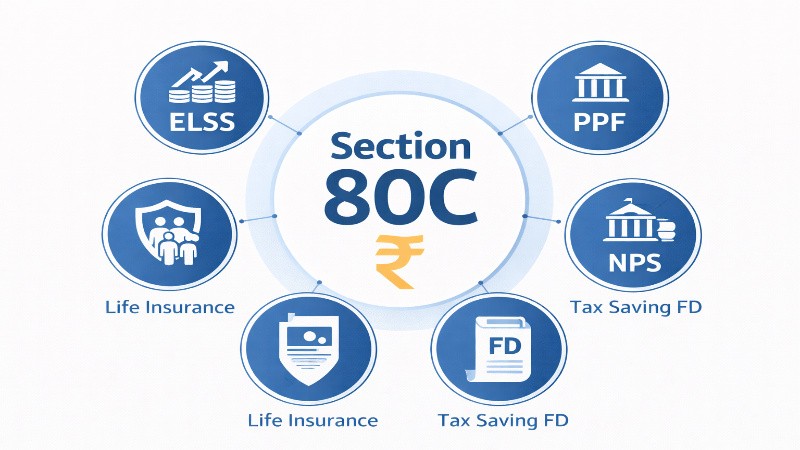
Maximum Tax Deduction You Can Claim
Rs 1,50,000Under Section 80C of the Income Tax Act, 1961 | Plus Additional Rs 50,000 under Section 80CCD(1B) for NPS
Tax season is here again, and if you are a salaried employee or a self-employed professional in India, you are probably wondering how to save the maximum tax legally under Section 80C. The good news is that the Income Tax Act gives you plenty of options to reduce your taxable income by up to Rs 1.5 lakh every financial year. But with so many choices available — from PPF and ELSS to NPS and tax-saver FDs — it can get confusing to decide where to park your money.
In this detailed guide, we will break down every tax-saving investment option under Section 80C for FY 2026-27. We will compare them side-by-side using easy-to-read tables, explain the lock-in periods, expected returns, and tax treatment, and help you build a smart tax-saving portfolio that matches your risk appetite and financial goals. Whether you are a young professional just starting your career or a senior citizen looking for safe returns, this article has something for everyone.
Before we dive in, here is a quick reality check: Section 80C is not just about saving tax. It is about building long-term wealth, securing your retirement, protecting your family with insurance, and creating a financial safety net. The best tax-saving strategy is one that aligns with your life goals, not just your tax bill. So let us explore every option in detail and help you make informed decisions.
What is Section 80C of the Income Tax Act?
Section 80C is one of the most popular and widely used provisions in the Income Tax Act, 1961. It allows individual taxpayers and Hindu Undivided Families (HUFs) to claim a deduction of up to Rs 1.5 lakh from their total taxable income by investing in specified financial instruments or incurring certain eligible expenses. This means if your taxable income is Rs 10 lakh and you invest Rs 1.5 lakh in 80C schemes, your taxable income drops to Rs 8.5 lakh — saving you a significant amount in taxes.
It is important to understand that Section 80C is a deduction, not a rebate. A deduction reduces your taxable income, while a rebate reduces your tax liability directly. The actual tax you save depends on which income tax slab you fall into. For someone in the 30% tax bracket, a Rs 1.5 lakh deduction under 80C can save up to Rs 46,800 in taxes (including 4% health and education cess). For someone in the 20% bracket, the savings would be around Rs 31,200. Even in the 5% bracket, you still save Rs 7,800 — which is not bad at all.
Key Point: The Rs 1.5 lakh limit under Section 80C is a combined limit. It includes investments under Section 80C, 80CCC (pension plans), and 80CCD(1) (NPS contribution). You cannot claim Rs 1.5 lakh under each section separately. The total across all three cannot exceed Rs 1.5 lakh.
Another important thing to remember is that Section 80C benefits are available only under the Old Tax Regime. If you have opted for the New Tax Regime (which offers lower tax rates but fewer deductions), you cannot claim 80C deductions. This is a crucial decision point every taxpayer must evaluate at the beginning of the financial year. For most people with significant investments and expenses, the Old Regime still works out better.
Complete List of Tax Saving Options Under Section 80C
Section 80C covers a wide range of investments and expenses. Here is the complete list of everything that qualifies for the Rs 1.5 lakh deduction:
| Category | Investment / Expense | Lock-in Period | Risk Level |
|---|---|---|---|
| Savings Schemes | Public Provident Fund (PPF) | 15 years | Very Low |
| Savings Schemes | National Savings Certificate (NSC) | 5 years | Very Low |
| Savings Schemes | Senior Citizen Savings Scheme (SCSS) | 5 years | Very Low |
| Savings Schemes | Sukanya Samriddhi Yojana (SSY) | 21 years (girl child) | Very Low |
| Savings Schemes | 5-Year Post Office Time Deposit | 5 years | Very Low |
| Mutual Funds | Equity Linked Savings Scheme (ELSS) | 3 years | Moderate to High |
| Insurance | Life Insurance Premium (LIC / Private) | Policy term | Low |
| Insurance | Unit Linked Insurance Plan (ULIP) | 5 years | Moderate |
| Retirement | Employee Provident Fund (EPF) | Retirement / 5 years | Very Low |
| Retirement | National Pension System (NPS) Tier 1 | Till retirement (60 years) | Moderate |
| Bank Deposits | Tax Saver Fixed Deposit (5-year) | 5 years | Very Low |
| Expenses | Home Loan Principal Repayment | NA | NA |
| Expenses | Tuition Fees for Children (max 2) | NA | NA |
| Expenses | Stamp Duty & Registration Charges | NA | NA |
Public Provident Fund (PPF) — The Safest Tax Saver
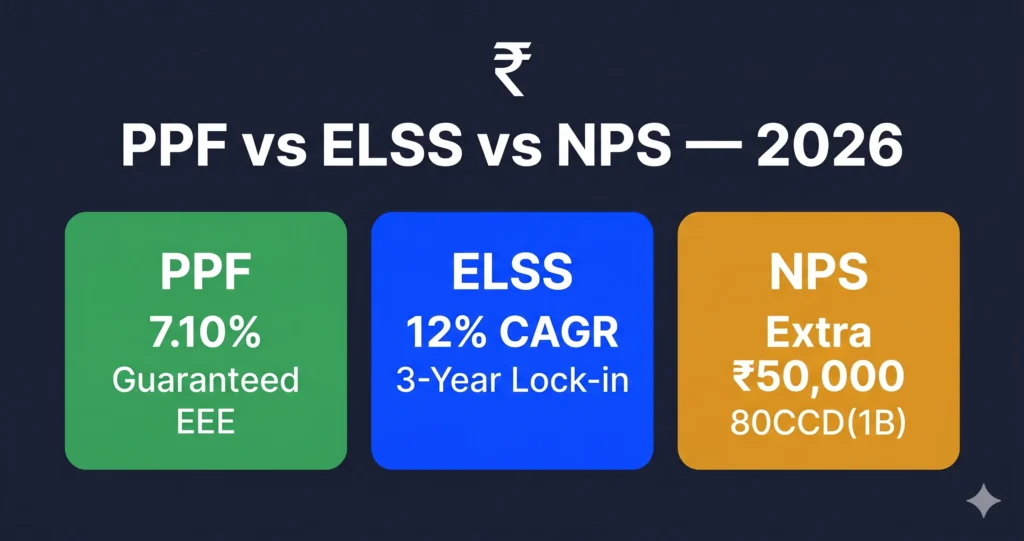
The Public Provident Fund (PPF) is arguably the most trusted tax-saving instrument in India. Backed by the Government of India, PPF offers a triple tax benefit — your contributions are deductible under 80C, the interest earned is tax-free, and the maturity amount is also completely tax-free. This is called the EEE (Exempt-Exempt-Exempt) tax status, and very few investment options offer this.
PPF is ideal for conservative investors who prioritize capital safety over high returns. The current interest rate for PPF is 7.1% per annum, which is reviewed quarterly by the government. While this may seem modest compared to equity returns, the power of compounding over 15 years can create significant wealth. Plus, the safety of government backing makes it perfect for risk-averse individuals, senior citizens, and those building a retirement corpus.
| Feature | Details |
|---|---|
| Interest Rate | 7.1% per annum (compounded annually, reviewed quarterly) |
| Minimum Investment | Rs 500 per year |
| Maximum Investment | Rs 1.5 lakh per year |
| Lock-in Period | 15 years (can be extended in blocks of 5 years) |
| Partial Withdrawal | Allowed from 7th year onwards |
| Loan Facility | Available from 3rd to 6th year |
| Tax Status | EEE (Exempt-Exempt-Exempt) |
| Where to Open | Post Office, Banks (SBI, HDFC, ICICI, etc.) |
| Best For | Conservative investors, long-term savers, retirement planning |
Pros and Cons of PPF
- Pros: Government-backed safety, EEE tax status, loan and partial withdrawal facilities, attractive interest rates for a safe instrument, can be opened for minors
- Cons: Very long lock-in of 15 years, interest rates are subject to government revision, not ideal for short-term goals, limited liquidity
Pro Tip: Invest in PPF before the 5th of every month to earn interest for that entire month. If you deposit on the 6th or later, you miss the interest for that month. Also, try to invest the full Rs 1.5 lakh at the beginning of the financial year (April) to maximize compounding benefits.
Equity Linked Savings Scheme (ELSS) — The Wealth Builder
If you are young, have a higher risk appetite, and want to build wealth while saving tax, ELSS mutual funds are your best friend. ELSS is the only pure equity investment option under Section 80C, and it has the shortest lock-in period of just 3 years among all 80C instruments. This makes it ideal for investors who want liquidity and higher returns.
ELSS funds invest primarily in equity and equity-related instruments, which means your money grows with the stock market. Historically, top ELSS funds have delivered CAGR returns of 12-15% over long periods, significantly outperforming fixed-income options like PPF and NSC. However, remember that equity returns are not guaranteed — they fluctuate with market conditions. In bad years, ELSS can give negative returns too. But if you stay invested for 7-10 years, the probability of good returns is very high.
| Feature | Details |
|---|---|
| Return Type | Market-linked (historical CAGR: 12-15%) |
| Minimum Investment | Rs 500 per month (SIP) or lumpsum |
| Maximum Investment | No upper limit (but 80C deduction capped at Rs 1.5 lakh) |
| Lock-in Period | 3 years (shortest among 80C options) |
| Tax on Returns | LTCG at 12.5% on gains exceeding Rs 1.25 lakh per year |
| Risk Level | Moderate to High |
| Where to Invest | Mutual fund platforms, AMC websites, brokers |
| Best For | Young professionals, growth-oriented investors, medium-term goals |
Top ELSS Funds to Consider (2026)
| Fund Name | 3-Year Returns | 5-Year Returns | AUM (Cr) |
|---|---|---|---|
| Quant Tax Plan | ~35% | ~28% | Rs 4,862 |
| Canara Robeco Equity Tax Saver | ~22% | ~20% | Rs 4,081 |
| Mirae Asset Tax Saver Fund | ~20% | ~19% | Rs 31,839 |
| SBI Long Term Equity Fund | ~18% | ~16% | Large |
| Axis Long Term Equity Fund | ~15% | ~14% | Large |
Important: Past returns do not guarantee future performance. Always check the fund's consistency, portfolio quality, and expense ratio before investing. Consider starting a SIP (Systematic Investment Plan) in ELSS rather than lumpsum to average out market volatility.
National Pension System (NPS) — The Retirement Champion
The National Pension System (NPS) is a government-sponsored retirement savings scheme that offers additional tax benefits beyond Section 80C. While your NPS Tier 1 contribution qualifies for the Rs 1.5 lakh limit under 80CCD(1) (which is part of the overall 80C limit), you can claim an extra Rs 50,000 deduction under Section 80CCD(1B). This means NPS can help you save tax on up to Rs 2 lakh in total — Rs 1.5 lakh under 80C and an additional Rs 50,000 exclusively for NPS.
NPS is a market-linked retirement product where your money is invested across equity, corporate bonds, government securities, and alternative assets based on your chosen allocation. You can select between Active Choice (where you decide the asset mix) and Auto Choice (where allocation changes automatically based on your age). The equity exposure is capped at 75% for most subscribers, which reduces as you approach retirement age.
| Feature | Details |
|---|---|
| Return Type | Market-linked (Tier 1 Equity: 8-12%, Govt Bonds: 6-8%) |
| Minimum Investment | Rs 1,000 per year |
| Maximum Investment | No upper limit |
| Lock-in Period | Till retirement (60 years); partial withdrawal allowed after 3 years |
| Tax Benefit 80C | Up to Rs 1.5 lakh under 80CCD(1) |
| Additional Tax Benefit | Extra Rs 50,000 under 80CCD(1B) — over and above 80C |
| Employer Contribution | Up to 10% of basic salary deductible under 80CCD(2) — no limit |
| Tax on Maturity | 60% lump sum tax-free; 40% must buy annuity (taxable as income) |
| Best For | Retirement planning, salaried employees, additional tax saving |
Pros and Cons of NPS
- Pros: Additional Rs 50,000 tax benefit beyond 80C, very low fund management charges (0.09%), professional pension fund management, partial withdrawal allowed for emergencies, portable across jobs
- Cons: Long lock-in till retirement, 40% compulsory annuity purchase, limited equity exposure (max 75%), annuity income is taxable, partial withdrawal has restrictions
National Savings Certificate (NSC) & Tax Saver Fixed Deposit
For investors who want guaranteed returns with complete safety, the National Savings Certificate (NSC) and 5-Year Tax Saver Fixed Deposits are excellent options. Both are backed by the government (NSC by post office, FD by banks) and offer fixed interest rates for the entire tenure.
The NSC VIII Issue currently offers an interest rate of 6.8% per annum, compounded annually but payable at maturity. The interest accrued for the first four years is deemed to be reinvested and qualifies for additional 80C deduction in those years. Only the fifth year's interest is taxable. This makes NSC a self-compounding tax saver — a unique feature no other instrument offers.
Tax Saver FDs are offered by almost all banks and have a lock-in of 5 years. Interest rates vary from bank to bank, typically ranging from 6.5% to 7.5%. Senior citizens get an additional 0.5% interest. The principal qualifies for 80C deduction, but the interest is fully taxable as per your income slab. This is a key difference from PPF where interest is tax-free.
| Feature | NSC | Tax Saver FD |
|---|---|---|
| Interest Rate | 6.8% (fixed) | 6.5% - 7.5% (varies by bank) |
| Lock-in Period | 5 years | 5 years |
| Minimum Investment | Rs 100 | Rs 100 - Rs 1,000 (varies by bank) |
| Maximum Investment | No limit | No limit |
| Tax on Interest | Taxable (but first 4 years interest reinvested gets 80C benefit) | Fully taxable as per slab |
| Where to Buy | Post Office | Any bank |
| Best For | Conservative investors, small savers | Bank customers, senior citizens |
Life Insurance Premium & Unit Linked Insurance Plan (ULIP)
Life insurance premiums paid for yourself, your spouse, or your children qualify for Section 80C deduction. This includes policies from LIC, private insurers, and even term insurance plans. However, there is a catch: for policies issued after April 1, 2012, the premium should not exceed 10% of the sum assured to claim full deduction. For policies issued before that date, the limit is 20%.
Term insurance is the purest form of life insurance — it offers high coverage at low premiums but has no maturity value. If you survive the policy term, you get nothing back. Endowment plans and money-back policies combine insurance with savings but offer lower returns (typically 4-6%). ULIPs (Unit Linked Insurance Plans) combine insurance with market-linked investments, but their charges are higher than pure mutual funds.
| Insurance Type | Premium | Returns | Best For |
|---|---|---|---|
| Term Insurance | Low | No maturity benefit | Pure protection, high coverage |
| Endowment Plan | High | 4-6% guaranteed | Conservative investors wanting savings + insurance |
| Money Back Plan | High | 4-5% with periodic payouts | Regular income needs |
| ULIP | Moderate to High | Market-linked (5-10%) | Those wanting insurance + equity exposure |
Golden Rule: Never mix insurance and investment. Buy a pure term plan for life cover and invest the remaining money in ELSS or PPF for better returns. ULIPs and endowment plans often give poor returns after deducting high charges.
Home Loan Principal Repayment & Tuition Fees
Not all Section 80C benefits come from investments. Some are expenses you already incur — and you can claim them too. The principal component of your home loan EMI qualifies for 80C deduction. This is a huge benefit for homeowners, as you are essentially getting tax savings for paying off your own house. However, remember that the interest component of your home loan is claimed under Section 24 (up to Rs 2 lakh for self-occupied property), not under 80C.
Tuition fees paid for your children's education also qualify for 80C deduction. This includes fees for full-time courses in schools, colleges, and universities in India. The deduction is available for up to two children. However, tuition fees do not include development fees, donation fees, or private coaching expenses. Both parents can claim the deduction for the same child, but the total cannot exceed the actual fees paid.
| Expense | 80C Deduction Available | Conditions |
|---|---|---|
| Home Loan Principal | Yes, up to Rs 1.5 lakh | Property should not be sold within 5 years of possession |
| Stamp Duty & Registration | Yes, one-time claim | Only in the year of purchase |
| Tuition Fees | Yes, up to Rs 1.5 lakh | Full-time courses only; max 2 children |
| Development Fees | No | Not eligible under 80C |
| Donation to School | No | Not eligible under 80C |
Sukanya Samriddhi Yojana & Senior Citizen Savings Scheme
The Sukanya Samriddhi Yojana (SSY) is a government scheme specifically designed for girl children. Parents or guardians can open an SSY account for a girl child below 10 years of age. The account matures when the girl turns 21, but partial withdrawals are allowed for higher education after she turns 18. SSY currently offers an interest rate of 7.6% per annum, which is higher than PPF. Like PPF, SSY also enjoys EEE tax status — making it one of the best long-term savings options for daughters.
The Senior Citizen Savings Scheme (SCSS) is available to individuals aged 60 years and above (55 years for those who took voluntary retirement). It offers an interest rate of 7.4% per annum, payable quarterly. The maximum investment limit is Rs 30 lakh, and the tenure is 5 years (extendable by 3 years). SCSS qualifies for 80C deduction and is ideal for retirees seeking regular income with safety.
| Feature | Sukanya Samriddhi Yojana | Senior Citizen Savings Scheme |
|---|---|---|
| Interest Rate | 7.6% per annum | 7.4% per annum |
| Minimum Investment | Rs 250 per year | Rs 1,000 |
| Maximum Investment | Rs 1.5 lakh per year | Rs 30 lakh total |
| Lock-in Period | 21 years (girl child) | 5 years (extendable by 3 years) |
| Tax Status | EEE | Interest taxable; principal deductible |
| Best For | Parents of girl children | Senior citizens seeking regular income |
Master Comparison Table: All Section 80C Investments Side by Side
Here is the ultimate comparison table that puts all major Section 80C investment options head-to-head. Use this to quickly decide which instruments suit your needs:
| Instrument | Returns | Lock-in | Risk | Tax on Returns | Best For |
|---|---|---|---|---|---|
| PPF | 7.1% (fixed) | 15 years | Very Low | Tax-free | Long-term safety |
| ELSS | 12-15% (market-linked) | 3 years | Moderate-High | LTCG above Rs 1.25L | Wealth creation |
| NPS | 8-12% (market-linked) | Till retirement | Moderate | Partially taxable | Retirement + extra tax benefit |
| NSC | 6.8% (fixed) | 5 years | Very Low | Taxable | 5-year fixed return |
| Tax Saver FD | 6.5-7.5% (fixed) | 5 years | Very Low | Taxable | Bank customers |
| Life Insurance | 4-6% (endowment) / No returns (term) | Policy term | Low | Tax-free (under conditions) | Family protection |
| ULIP | 5-10% (market-linked) | 5 years | Moderate | Tax-free (under conditions) | Insurance + investment mix |
| SSY | 7.6% (fixed) | 21 years | Very Low | Tax-free | Girl child's future |
| SCSS | 7.4% (fixed) | 5 years | Very Low | Taxable | Senior citizens |
| EPF | 8.15% (fixed) | Retirement | Very Low | Tax-free (if 5+ years) | Salaried employees |
How Much Tax Will You Actually Save? Real Calculation
Let us look at a practical example to understand how much tax you actually save by investing Rs 1.5 lakh under Section 80C. We will consider three taxpayers in different tax brackets:
| Particulars | Taxpayer A (5% Slab) | Taxpayer B (20% Slab) | Taxpayer C (30% Slab) |
|---|---|---|---|
| Gross Taxable Income | Rs 5,50,000 | Rs 10,50,000 | Rs 15,50,000 |
| Standard Deduction | Rs 50,000 | Rs 50,000 | Rs 50,000 |
| Income after Standard Deduction | Rs 5,00,000 | Rs 10,00,000 | Rs 15,00,000 |
| Section 80C Investment | Rs 1,50,000 | Rs 1,50,000 | Rs 1,50,000 |
| Taxable Income after 80C | Rs 3,50,000 | Rs 8,50,000 | Rs 13,50,000 |
| Tax Liability (Old Regime) | Rs 2,500 | Rs 82,500 | Rs 2,17,500 |
| Tax Saved Due to 80C | Rs 7,500 | Rs 31,200 | Rs 46,800 |
| Effective Return on Investment | 5% + scheme returns | 20.8% + scheme returns | 31.2% + scheme returns |
Key Insight: The higher your tax bracket, the more you save. For a 30% slab taxpayer, investing Rs 1.5 lakh in 80C effectively gives you an immediate 31.2% return (tax saved) plus the actual returns from the investment. This is why 80C investing is so powerful for high-income earners.
Smart Tax-Saving Portfolio Strategies for Different Age Groups
There is no one-size-fits-all approach to Section 80C investing. Your ideal portfolio depends on your age, income, risk appetite, and financial goals. Here are three proven strategies for different life stages:
Strategy 1: For Young Professionals (Age 22-30)
At this stage, you have a long investment horizon and can afford to take higher risks for better returns. Your portfolio should be equity-heavy with some safe allocation.
| Instrument | Allocation | Amount (Rs) | Reason |
|---|---|---|---|
| ELSS (SIP) | 40% | 60,000 | Wealth creation, shortest lock-in |
| NPS Tier 1 | 30% | 45,000 | Extra Rs 50K benefit, retirement planning |
| PPF | 20% | 30,000 | Safety, long-term compounding |
| Term Insurance | 10% | 15,000 | Family protection |
Strategy 2: For Mid-Career Professionals (Age 31-45)
You likely have family responsibilities, a home loan, and children’s education to plan for. Your portfolio should be balanced between growth and safety.
| Instrument | Allocation | Amount (Rs) | Reason |
|---|---|---|---|
| ELSS | 30% | 45,000 | Growth component |
| PPF | 25% | 37,500 | Safety, retirement corpus |
| Home Loan Principal | 25% | 37,500 | Already paying, automatic 80C benefit |
| Life Insurance | 10% | 15,000 | Family protection |
| NPS | 10% | 15,000 | Additional tax benefit |
Strategy 3: For Senior Citizens (Age 60+)
Capital preservation and regular income are your priorities. Avoid equity-heavy options and focus on safe, fixed-return instruments.
| Instrument | Allocation | Amount (Rs) | Reason |
|---|---|---|---|
| SCSS | 35% | 52,500 | Highest safe returns, quarterly income |
| Tax Saver FD | 30% | 45,000 | Bank safety, senior citizen rates |
| PPF Extension | 20% | 30,000 | Tax-free returns |
| Life Insurance | 15% | 22,500 | Legacy planning |
Old Tax Regime vs New Tax Regime: Where Does 80C Fit?
Since FY 2020-21, Indian taxpayers have the option to choose between the Old Tax Regime and the New Tax Regime. This choice significantly impacts your 80C strategy. Under the New Regime, you get lower tax rates but forfeit most deductions including Section 80C. Under the Old Regime, you pay higher rates but can claim 80C, 80D, HRA, and other deductions.
| Income Slab | Old Regime Rate | New Regime Rate |
|---|---|---|
| Up to Rs 2.5 lakh | Nil | Nil |
| Rs 2.5 - 5 lakh | 5% | 5% |
| Rs 5 - 7.5 lakh | 10% | 10% |
| Rs 7.5 - 10 lakh | 15% | 15% |
| Rs 10 - 12.5 lakh | 20% | 20% |
| Rs 12.5 - 15 lakh | 25% | 25% |
| Above Rs 15 lakh | 30% | 30% |
Here is the simple rule of thumb: if your total deductions (80C + 80D + HRA + home loan interest + others) exceed Rs 3.5 - 4 lakh, the Old Regime is usually better. If your deductions are lower, the New Regime might save you more tax. Use an online tax calculator to compare both regimes before filing your return.
Remember: You must choose your tax regime at the time of filing your ITR. For salaried employees, you can inform your employer about your choice so they deduct TDS accordingly. However, you can still switch regimes when filing your final return.
Common Mistakes to Avoid While Claiming Section 80C Deductions
Even seasoned taxpayers make mistakes when it comes to Section 80C. Here are the most common pitfalls and how to avoid them:
- Investing only in March: Many people rush to invest in 80C schemes only in March, the last month of the financial year. This is a mistake because you lose 11 months of compounding benefits. Start your SIPs in April and invest systematically throughout the year.
- Ignoring the combined limit: Remember that 80C, 80CCC, and 80CCD(1) share the same Rs 1.5 lakh limit. Do not assume you can claim Rs 1.5 lakh in each separately.
- Buying wrong insurance: Endowment plans and money-back policies give poor returns (4-6%) after high charges. Stick to term insurance for protection and invest separately in ELSS or PPF.
- Not tracking automatic deductions: Your EPF contribution, home loan principal, and tuition fees are automatic 80C deductions. Track them so you do not over-invest in other instruments and block liquidity unnecessarily.
- Forgetting the lock-in: Every 80C instrument has a lock-in. Do not invest money you might need urgently. ELSS has the shortest lock-in (3 years), while PPF has the longest (15 years).
- Missing the NPS extra benefit: Many taxpayers forget that NPS offers an additional Rs 50,000 deduction under 80CCD(1B). This is over and above the Rs 1.5 lakh limit — a total of Rs 2 lakh tax saving potential.
- Not keeping proof: Always keep investment receipts, premium certificates, and bank statements. The Income Tax Department can ask for proof up to 7 years after the assessment year.
Related Financial & Legal Resources on Barristery.in
At Barristery.in, we believe financial literacy and legal awareness go hand in hand. Understanding tax laws is just as important as knowing your legal rights. If you found this tax-saving guide helpful, explore these related resources from our website:
- Biswanath Singh Institute of Legal Studies, Munger — Complete Guide for Law Aspirants — Planning a career in law? This comprehensive guide covers everything from admission procedures to career prospects at one of Bihar's emerging legal institutions. A must-read for future legal professionals.
- Legal Careers Portal — LL.B Jobs, Internships & Moot Court Competitions — Your daily destination for legal job alerts, internship opportunities, moot court competitions, and essay competitions. Stay updated with the latest career opportunities in the legal world.
- About Barristery.in — Your Legal Knowledge Partner — Learn more about our mission to make Indian law accessible, understandable, and actionable for every citizen, student, and legal professional. Founded by Rabi Kumar Pandit, a legal professional with a unique multidisciplinary background.
Did You Know? Tax planning is not just about saving money — it is also about legal compliance. The Income Tax Act has strict penalties for false claims and under-reporting. Always invest through proper channels, maintain documentation, and file your returns honestly. At Barristery.in, we advocate for both financial wisdom and legal integrity.
Conclusion: Build Your Tax-Saving Portfolio Wisely
Section 80C is one of the most powerful tools in your tax-saving arsenal. With a Rs 1.5 lakh deduction limit, it can save you anywhere from Rs 7,500 to Rs 46,800 in taxes every year, depending on your income slab. But the real benefit goes beyond tax savings — it is about building a disciplined savings habit, creating long-term wealth, and securing your financial future.
The key to successful tax planning is diversification. Do not put all your money in one instrument. A balanced mix of ELSS (for growth), PPF (for safety), NPS (for retirement and extra tax benefit), and term insurance (for protection) can create a robust portfolio. Add your automatic deductions like EPF, home loan principal, and tuition fees, and you will find that reaching the Rs 1.5 lakh limit is easier than you think.
Remember, the best time to start tax planning is April, not March. Start your SIPs early, review your portfolio mid-year, and make adjustments if needed. Use the comparison tables in this guide to evaluate your options, and do not hesitate to consult a certified financial planner if you need personalized advice.
Tax evasion is illegal, but tax avoidance through smart planning is your right. Use Section 80C wisely, stay compliant, and watch your wealth grow while keeping more of your hard-earned money in your pocket.
Stay Updated: Tax laws and interest rates change frequently. Bookmark this page and visit Barristery.in regularly for the latest updates on tax planning, financial literacy, and legal awareness. We are committed to helping you make informed decisions that protect both your wealth and your rights.
Last Updated: July 2026 | Article Published on Barristery.in | Disclaimer: Tax rates and interest rates are subject to government notification. Please verify current rates before investing.


COMMENTS