
World Population Day 2026: Theme, History, Significance, Objectives & Global Impact
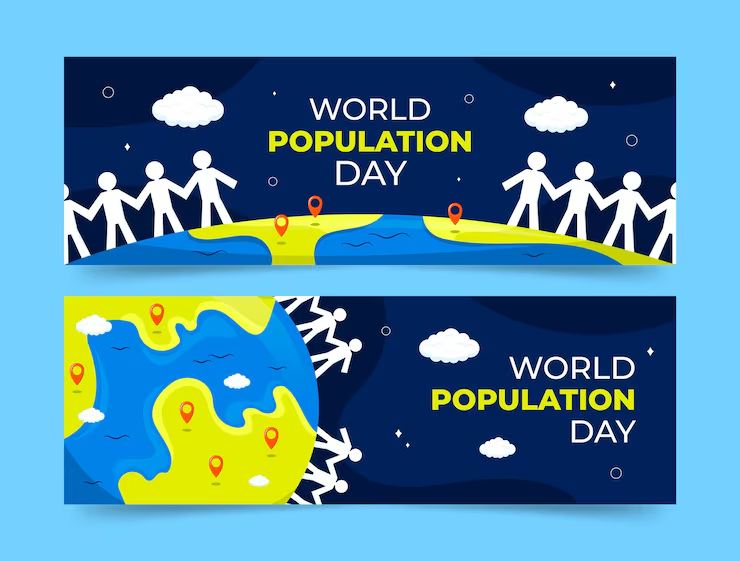
World Population Day 2026 Theme
"Realizing the hopes and aspirations of young people – today and for the future"Announced by United Nations Population Fund (UNFPA)
Every year on July 11, the world comes together to observe World Population Day — a day dedicated to raising awareness about global population issues, their impact on sustainable development, and the urgent need for informed policy-making. In 2026, as the global population crosses the staggering milestone of 8.3 billion people, this observance carries more weight than ever before. It is not just about numbers on a chart; it is about real lives, real challenges, and real opportunities that shape the future of humanity.
Whether you are a student preparing for competitive exams, a policy maker, a social worker, or simply a curious citizen who cares about the planet, understanding World Population Day is essential. In this comprehensive guide, we will explore everything you need to know — from the history and origin of this day to the 2026 theme, its significance, key objectives, and how different countries, including India, are responding to population challenges. We have also included detailed tables for easy reference and quick learning.
World Population Day 2026: At a Glance
Before diving deep into the details, here is a quick snapshot of everything you need to know about World Population Day 2026:
| Particulars | Details |
|---|---|
| Event Name | World Population Day 2026 |
| Date | 11 July 2026 (Saturday) |
| Observed By | United Nations (UN), UNFPA, Governments, NGOs, Educational Institutions, Civil Society |
| Origin | Inspired by the "Day of Five Billion" on 11 July 1987, when world population reached 5 billion |
| Established | 1989 by UNDP Governing Council; First observed on 11 July 1990 in 90+ countries |
| 2026 Theme | "Realizing the hopes and aspirations of young people – today and for the future" |
| Current World Population (2026) | Approximately 8.3 billion |
| Key Focus Areas | Youth empowerment, reproductive rights, gender equality, family planning, sustainable development |
| UN Resolution | UN General Assembly Resolution 45/216 (December 1990) |
History of World Population Day: How It All Began
The story of World Population Day begins with a moment that shook the world — the day humanity crossed the 5 billion mark. On 11 July 1987, demographers estimated that the global population had reached approximately five billion people. This event, informally called the "Day of Five Billion," generated unprecedented public interest. Newspapers around the world covered it extensively. People everywhere began talking about what this massive number meant for the future of our planet.
The overwhelming public response to the "Day of Five Billion" made one thing clear: population issues needed a dedicated platform for sustained dialogue. The United Nations Development Programme (UNDP) took note of this growing concern. In 1989, the UNDP Governing Council formally established World Population Day, setting the date as 11 July to commemorate the anniversary of the five-billion milestone. The intent was to convert a one-time news cycle into a recurring platform for action on family planning, gender equality, maternal health, and sustainable development.
The first World Population Day was observed on 11 July 1990, with participation from more than 90 countries. Since then, the United Nations Population Fund (UNFPA) has led global coordination efforts, working with governments, schools, advocacy groups, and civil society organizations to organize seminars, campaigns, and awareness programs tied to this date. In December 1990, the UN General Assembly adopted Resolution 45/216, formally establishing the annual observance of World Population Day and enhancing awareness of population issues, including their relations to the environment and development.
Key Milestone: The world's population reached 7 billion on 31 October 2011 and surpassed 8 billion in late 2022. Each milestone has prompted renewed global conversations about resource management, healthcare access, and sustainable development.
Timeline of World Population Milestones
| Year | Population Milestone | Significance |
|---|---|---|
| 1804 | 1 Billion | First time human population reached 1 billion; took all of human history |
| 1927 | 2 Billion | Industrial Revolution and medical advances accelerated growth |
| 1960 | 3 Billion | Post-WWII baby boom and improved healthcare in developing nations |
| 1974 | 4 Billion | Rapid growth in Asia, Africa, and Latin America |
| 1987 | 5 Billion | "Day of Five Billion" — inspired creation of World Population Day |
| 1999 | 6 Billion | UN recognized the need for sustainable development goals |
| 2011 | 7 Billion | Major UN campaign on "7 Billion Actions" launched |
| 2022 | 8 Billion | Global focus shifted to demographic diversity and aging populations |
| 2026 | 8.3 Billion (estimated) | Theme focuses on youth empowerment and future aspirations |
World Population Day 2026 Theme: What It Means
The United Nations Population Fund (UNFPA) has announced the official theme for World Population Day 2026 as:
This theme is deeply meaningful and timely. It draws on findings from the UNFPA Demographic Futures Survey, one of the largest global surveys of its kind, capturing the views of more than 108,000 internet-connected young adults aged 18 to 39 across 73 countries. The survey report, titled "Lives, Choices and Futures: What young people want and what shapes their decisions about relationships and parenthood," offers a global snapshot of what young adults today want from relationships, family life, and the future — and what they feel is standing in their way.
The 2026 theme emphasizes several critical dimensions:
- Youth Empowerment: Young people represent the largest demographic group in many countries. Investing in their education, health, skills, and rights is essential for sustainable development.
- Informed Choices: The theme highlights that many young people want to build families but face barriers like economic insecurity, lack of healthcare access, gender inequality, and limited reproductive rights.
- Demographic Dividend: Countries with large youth populations can harness this "demographic dividend" if they invest in education, employment, and health services.
- Future Planning: The theme connects today's youth aspirations with long-term sustainable development, ensuring that population policies are people-centered rather than numbers-driven.
Year-by-Year Themes: A Look Back
| Year | World Population Day Theme |
|---|---|
| 2026 | "Realizing the hopes and aspirations of young people – today and for the future" |
| 2025 | "Empowering young people to create the families they want in a fair and hopeful world" |
| 2024 | "To Leave No One Behind, Count Everyone" |
| 2023 | "Unleashing the power of gender equality: Uplifting the voices of women and girls to unlock our world's infinite possibilities" |
| 2022 | "A world of 8 billion: Towards a resilient future for all - Harnessing opportunities and ensuring rights and choices for all" |
| 2021 | "The impact of the Covid-19 pandemic on fertility" |
| 2020 | "How to safeguard the health and rights of women and girls amid the Covid-19 pandemic" |
| 2019 | "25 years of the ICPD: accelerating the promise" |
| 2018 | "Family Planning is a Human Right" |
| 2017 | "Family Planning: Empowering People, Developing Nations" |
| 2016 | "Investing in Teenage Girls" |
Why World Population Day Matters: Significance and Global Relevance
World Population Day is not just another date on the calendar. It is a global call to action that compels individuals, communities, and governments to acknowledge the challenges and opportunities associated with our growing global population. Here is why this day holds immense significance in 2026:
1. Raising Awareness About Population Growth
The global population is growing at an unprecedented rate. According to the United Nations Department of Economic and Social Affairs, although the global population growth rate will continue to decline in the coming decades, the world's population will likely be 20-30% greater in 2050 than in 2020. This growth puts immense pressure on natural resources, healthcare systems, education infrastructure, and employment opportunities. World Population Day brings these issues into sharp focus.
2. Promoting Reproductive Health and Family Planning
Access to family planning services and reproductive healthcare remains a critical challenge in many parts of the world. The day advocates for universal access to voluntary family planning, which allows individuals and couples to make informed decisions about the number and spacing of their children. This is not just a health issue — it is a human rights issue.
3. Highlighting Gender Equality
Women and girls make up nearly 50% of the world's population, yet they continue to face systemic barriers in education, employment, healthcare, and political participation. World Population Day underscores the importance of gender equality as a cornerstone of sustainable development. When women are empowered, economies prosper, child mortality declines, and communities thrive.
4. Addressing Environmental Sustainability
Population growth is directly linked to environmental challenges such as climate change, deforestation, water scarcity, and biodiversity loss. As more people compete for limited resources, the strain on our planet becomes unsustainable. The day encourages discussions on sustainable consumption patterns, conservation of natural resources, and climate action.
5. Supporting Youth Development
With the 2026 theme focusing on young people, the day emphasizes investing in education, skills training, healthcare, and employment opportunities for the youth. Countries that successfully harness their youth demographic dividend see accelerated economic growth and social progress.
6. Advancing the Sustainable Development Goals (SDGs)
World Population Day is closely aligned with the UN's Sustainable Development Goals, particularly:
- SDG 3: Good Health and Well-being
- SDG 4: Quality Education
- SDG 5: Gender Equality
- SDG 8: Decent Work and Economic Growth
- SDG 10: Reduced Inequalities
- SDG 13: Climate Action
Did You Know? According to UNFPA's State of World Population report, across a 14-country survey covering more than a third of the global population, 18% of adults of reproductive age said they expect to end up with fewer or more children than they actually want. The barriers cited most often were the cost of raising a child, job insecurity, and the price of housing — not a lack of desire to become parents.
Key Objectives of World Population Day 2026
The observance of World Population Day serves multiple interconnected objectives that go beyond mere awareness-raising. Here are the core goals that guide global efforts on this day:
Primary Objectives
- To raise awareness about global population challenges and their impact on society, economy, and environment.
- To promote family planning and informed reproductive choices for all individuals and couples.
- To improve access to quality reproductive and maternal healthcare services as part of essential primary health care.
- To empower young people to achieve their hopes and aspirations through education, skills, and opportunities.
- To promote gender equality and protect the rights of women and girls in all spheres of life.
- To encourage responsible parenthood and healthy family practices.
- To ensure universal access to education, healthcare, and essential services for every individual.
- To support adolescent health and informed decision-making about relationships and parenthood.
- To promote sustainable use of natural resources and protect the environment for future generations.
- To contribute to achieving the Sustainable Development Goals (SDGs) through inclusive and sustainable population policies.
Secondary Objectives
- Advocacy for Policies: Granting policymakers, governments, and NGOs a platform to strengthen advocacy for population-related development programs.
- Human Rights Protection: Underscoring the paramount importance of human rights, with particular emphasis on reproductive rights and women's empowerment.
- Global Cooperation: Promoting international cooperation and building partnerships to efficiently resolve shared population concerns.
- Long-term Planning: Providing a platform for discussions on long-term plans and preparedness for demographic shifts.
- Data Collection: Encouraging accurate population census and data collection to ensure no one is left behind in development planning.
Global Population Trends: Key Statistics for 2026
Understanding population dynamics requires looking at the numbers. Here are the most critical global population statistics and trends that shape the context for World Population Day 2026:
Major Population Trends
| Trend | Details | Impact |
|---|---|---|
| Declining Fertility Rates | Global fertility dropped from 4.5 children per woman in 1970s to below 2.5 by 2015 | Aging populations in developed countries; labor shortages; pension crises |
| Increasing Life Expectancy | Rose from 64.6 years (1990s) to 72.6 years (2019) | Strain on healthcare systems; need for elderly care infrastructure |
| Rapid Urbanization | About 66% of global population expected to live in cities by 2050 | Pressure on housing, transportation, water, and sanitation systems |
| Youth Bulge in Developing Nations | Sub-Saharan Africa, South Asia have large youth populations | Opportunity for demographic dividend if invested in education and jobs |
| Aging in Developed Nations | Japan, Italy, Germany facing "Silver Tsunami" with 65+ population growing | Increased healthcare costs; shrinking workforce; immigration needs |
| Gender Imbalance | In some regions, sex-selective practices have skewed male-female ratios | Social instability; marriage market distortions; human rights concerns |
Top 10 Most Populous Countries in 2026
| Rank | Country | Estimated Population (2026) | % of World Population |
|---|---|---|---|
| 1 | India | ~1.45 Billion | ~17.5% |
| 2 | China | ~1.42 Billion | ~17.1% |
| 3 | United States | ~340 Million | ~4.1% |
| 4 | Indonesia | ~280 Million | ~3.4% |
| 5 | Pakistan | ~240 Million | ~2.9% |
| 6 | Nigeria | ~230 Million | ~2.8% |
| 7 | Brazil | ~215 Million | ~2.6% |
| 8 | Bangladesh | ~175 Million | ~2.1% |
| 9 | Russia | ~145 Million | ~1.7% |
| 10 | Ethiopia | ~130 Million | ~1.6% |
World Population Day and India: The World's Most Populous Nation
In April 2023, India officially surpassed China to become the world's most populous country. With approximately 1.45 billion people in 2026, India alone accounts for nearly 17.5% of the world's population. This demographic reality makes India's approach to population management critically important not just for the subcontinent, but for the entire world.
India's Population Profile
| Indicator | India (2026 Estimates) | Global Comparison |
|---|---|---|
| Total Population | ~1.45 Billion | World's #1 (surpassed China in 2023) |
| Median Age | ~28.7 Years | One of the youngest large populations globally |
| Fertility Rate | ~2.0 (Replacement Level) | Declined from 5.9 in 1950 to near replacement level |
| Urban Population | ~36% | Lower than global average; rapid urbanization ongoing |
| Literacy Rate | ~77.7% | Significant gender gap remains (Male: 84%, Female: 71%) |
| Youth Population (15-29 years) | ~27% of total population | Huge demographic dividend potential |
Key Challenges for India
- Employment Generation: Creating meaningful jobs for the millions entering the workforce every year remains India's biggest challenge.
- Education Quality: While enrollment rates have improved, the quality of education and skill development needs massive investment.
- Healthcare Access: Rural areas still lack adequate healthcare infrastructure, particularly maternal and child health services.
- Gender Disparity: Female literacy, workforce participation, and political representation remain significantly lower than male counterparts.
- Resource Pressure: Water scarcity, food security, and energy demands are intensifying with population growth.
- Urban Infrastructure: Rapid, unplanned urbanization is creating slums, pollution, and strained public services.
India's Initiatives and Policies
- National Population Policy (2000): Aimed at stabilizing population by 2045 through education, healthcare, and voluntary family planning.
- Beti Bachao Beti Padhao: Campaign to address gender-biased sex selection and promote girls' education.
- Ayushman Bharat: World's largest government-funded healthcare scheme covering 500 million people.
- Skill India Mission: Training millions of youth in employable skills to harness the demographic dividend.
- Swachh Bharat Abhiyan: Improved sanitation coverage, directly impacting public health and dignity.
How World Population Day 2026 is Celebrated Across the Globe
World Population Day is observed through a wide range of activities organized by governments, UN agencies, NGOs, educational institutions, and civil society organizations. Here is how different stakeholders contribute to the observance:
Government Activities
- Organizing seminars and conferences on population policy and family planning
- Launching new healthcare schemes and reproductive health programs
- Releasing population data reports and census findings
- Conducting awareness campaigns in rural and urban areas
- Honoring individuals and organizations for outstanding contributions to population welfare
UN and International Organizations
- UNFPA coordinates global campaigns and publishes the State of World Population report
- WHO focuses on maternal health, family planning, and reproductive healthcare
- UNESCO promotes education, especially for girls and young women
- UNDP addresses the development dimensions of population dynamics
- The United Nations Population Award Ceremony honors exceptional contributions (2026 ceremony: July 8 at UN Headquarters, New York)
Educational Institutions
- Organizing essay competitions, debates, and quizzes on population issues
- Inviting experts for lectures and panel discussions
- Screening documentaries on population, environment, and development
- Conducting student research projects on local demographic trends
- Creating awareness through posters, banners, and social media campaigns
Civil Society and NGOs
- Organizing community health camps and family planning counseling sessions
- Distributing educational materials in local languages
- Advocating for policy changes through rallies and public meetings
- Running social media campaigns with hashtags like #WorldPopulationDay
- Partnering with local leaders to address cultural barriers to family planning
Inspiring Quotes on World Population Day
Words have the power to inspire action. Here are some thought-provoking quotes from global leaders and thinkers that capture the essence of World Population Day:
"The world has enough for everyone's needs, but not enough for everyone's greed." — Mahatma Gandhi
"Overpopulation is a root problem of all environmental issues." — John Robbins, Environmentalist
"A peaceful world cannot exist when only one-third are rich and two-thirds go hungry." — John Boyd Orr, Nobel Peace Prize Laureate
"The future of the world depends on the education of all people." — Kofi Annan, Former UN Secretary-General
"Development is the best contraceptive." — Lester Brown, Environmentalist
"The raging monster upon the land is population growth. In its presence, sustainability is but a fragile theoretical concept." — Paul R. Ehrlich, Scientist
Related Resources from Barristery.in
At Barristery.in, we believe that understanding global issues like population dynamics is essential for every informed citizen and law student. If you found this article insightful, explore these related resources from our platform:
- About Barristery.in — Your Legal Knowledge Partner — Learn more about our mission to make Indian law accessible, understandable, and actionable for every citizen, student, and legal professional. Founded by Rabi Kumar Pandit, a legal professional with a unique multidisciplinary background in History, Economics, and Law.
- Legal Careers Portal — LL.B Jobs, Internships & Moot Court — Your one-stop destination for daily legal job alerts, internship opportunities, moot court competitions, essay competitions, and call for blogs from top law firms and organizations. Stay updated with the latest career opportunities in the legal field.
- Barristery Communities — Join Our Official Networks — Connect with Barristery on WhatsApp, LinkedIn, and Telegram for the latest job updates, internships, government exam alerts, legal news, career opportunities, and study materials directly on your favorite platforms.
Did You Know? Barristery.in is a focused, independent legal knowledge platform where every article is personally curated by Rabi Kumar Pandit to ensure accuracy and usefulness. Our multidisciplinary approach — combining History, Economics, and Law — helps us examine issues like population policy through their broader social, economic, and political context.
Frequently Asked Questions (FAQs) About World Population Day
When is World Population Day celebrated?
World Population Day is celebrated annually on 11 July. In 2026, it falls on a Saturday.
Why was 11 July chosen as World Population Day?
The date commemorates the "Day of Five Billion" on 11 July 1987, when the world's population reached approximately 5 billion people. This milestone sparked global interest in population issues.
Who announces the World Population Day theme?
The United Nations Population Fund (UNFPA) announces the annual theme in coordination with the United Nations system.
What is the world population in 2026?
The world population in 2026 is estimated to be approximately 8.3 billion people.
Which country has the highest population in 2026?
India is the world's most populous country in 2026, with approximately 1.45 billion people, having surpassed China in April 2023.
How can I participate in World Population Day 2026?
You can participate by:
- Sharing awareness posts on social media using #WorldPopulationDay
- Organizing or attending seminars and discussions in your community
- Volunteering with NGOs working on family planning and reproductive health
- Educating yourself and others about population issues through reliable resources
- Writing to your elected representatives about population-related policies
Is World Population Day a public holiday?
No, World Population Day is not a public holiday. It is an international observance day. Offices, schools, and businesses remain open as usual, though many organizations hold special events.
What is the UN Population Award?
The United Nations Population Award is presented annually to individuals and institutions in recognition of outstanding contributions to population and reproductive health questions. The 2026 Award Ceremony will be held on 8 July 2026 at UN Headquarters in New York.
Conclusion: Shaping Our Shared Future
World Population Day 2026 reminds us that population is not just about numbers — it is about people. Every statistic represents a life, a dream, a challenge, and an opportunity. As the global community crosses the 8.3 billion mark, the choices we make today will determine the kind of world we leave for future generations.
The theme "Realizing the hopes and aspirations of young people – today and for the future" is a powerful call to action. It tells us that investing in youth is not optional — it is essential. When young people have access to education, healthcare, decent work, and reproductive rights, they become the engines of innovation, economic growth, and social progress. When they are denied these opportunities, the demographic dividend becomes a demographic disaster.
For a country like India, which holds the distinction of being the world's most populous nation, this day carries special significance. With a young, dynamic population and a fertility rate nearing replacement level, India stands at a crossroads. The path it chooses — whether to invest in human capital or ignore it — will shape not just India's future, but the world's.
As individuals, we may feel small in the face of global challenges. But history shows that collective action starts with individual awareness. By understanding population issues, advocating for reproductive rights, supporting gender equality, and making sustainable choices, each of us contributes to a healthier, more equitable, and more sustainable world.
Stay Informed: Bookmark this article and visit Barristery.in regularly for more insightful articles on global awareness days, legal knowledge, career guidance, and current affairs. We are committed to making complex topics accessible and actionable for every reader.
Last Updated: July 2026 | Article Published on Barristery.in


COMMENTS